Статья опубликована в рамках: CCXXXIV Международной научно-практической конференции «Научное сообщество студентов: МЕЖДИСЦИПЛИНАРНЫЕ ИССЛЕДОВАНИЯ» (Россия, г. Новосибирск, 09 апреля 2026 г.)
Наука: Педагогика
Скачать книгу(-и): Сборник статей конференции
дипломов
THE USE OF AUTHENTIC MATERIALS AS A MEANS OF ENHANCING STUDENTS' LANGUAGE COMPETENCE

ABSTRACT
This study explores the use of authentic materials in enhancing students’ English language competence. A quantitative survey of 20 learners examined their preferences, frequency of use, and perceived effectiveness of such materials. The results show that digital resources, particularly social media and songs, are the most popular, followed by films and TV series, while traditional materials are less frequently used. Listening skills are the most improved, along with vocabulary, whereas speaking and writing are less affected. Overall, authentic materials increase motivation and engagement, but their effectiveness depends on proper integration into the learning process.
Keywords: authentic materials, language competence, English learning, digital resources, motivation, listening skills, vocabulary acquisition.
Introduction
In recent years, the process of language learning has undergone significant transformation due to the rapid development of digital technologies and increased access to global media. Traditional teaching methods, which rely heavily on textbooks and structured exercises, are gradually being supplemented by more dynamic and engaging approaches. One of the most prominent among these approaches is the use of authentic materials.
Authentic materials refer to real-life language resources that are not specifically created for educational purposes. These include social media content, songs, films, podcasts, and news articles. Such materials expose learners to natural language use, including informal expressions, real discourse patterns, and cultural context, which are often absent in traditional textbooks.
The importance of authentic materials lies in their ability to bridge the gap between classroom learning and real-world communication. They provide learners with meaningful input and create opportunities for language acquisition in realistic contexts. It is widely accepted that language is acquired more effectively when learners are exposed to input slightly above their current level of competence [3, p. 3].
Moreover, authentic materials contribute significantly to learners’ motivation and engagement. Since these resources are closely related to everyday life and personal interests, they make the learning process more relevant and enjoyable. Research also suggests that learners demonstrate higher levels of involvement and positive attitudes when authentic materials are incorporated into the learning process [4, p. 145].
In addition to linguistic development, authentic materials support the formation of sociolinguistic competence. They allow learners to understand how language is used in different social contexts, helping them develop not only accuracy but also appropriateness in communication.
Despite their advantages, the use of authentic materials requires careful planning and methodological support. Without proper guidance, learners may face difficulties related to vocabulary, speed of speech, or cultural references. Therefore, it is important to adapt materials to learners’ proficiency levels and provide structured tasks that facilitate comprehension.
This study aims to explore the role of authentic materials in enhancing students’ language competence, focusing on learners’ preferences, frequency of use, and the impact on different language skills.
Methodology
The study employed a quantitative survey design to investigate the role of authentic materials in language learning. A total of 20 students with different levels of English proficiency, including B1, B2, and C1, participated in the research, allowing for a broader perspective on the issue. Data was collected through an online questionnaire consisting of closed-ended and one open-ended question, focusing on the types of authentic materials used, frequency of engagement, perceived effectiveness, and their impact on language skills. The final open-ended question aimed to provide deeper insights into how authentic materials can be used more effectively in the learning process. The collected data was analyzed using descriptive statistics, including percentages and frequency distribution, to identify common trends and patterns, and despite the small sample size and reliance on self-reported data, the study offers valuable insights into students’ attitudes toward authentic materials and their role in language learning.
Results
The survey involved 20 respondents, and the quantitative analysis represented the dominant trend in digitalization and the frequent use of authentic materials. The two most significant metrics were chosen to fully showcase the topic. The data indicated that the main preference is aimed towards contemporary formats rather than traditional ones. Social media and songs share the highest usage rate, each being utilized by 65% of learners (13 out of 20), films and TV series being in a close circle and making up 55% of the total(11 respondents). In contrast, more traditional authentic materials, such as articles and news, are used by the minority, 25% respectively, and podcasts are established on a lower level (15%). Regarding the influence of these materials on respondents’ language competencies, listening is the skill that comes first, with 15(75%) people having chosen this option, surpassing all the other competencies. Vocabulary acquisition comes second, accounting for half of the total number of respondents (50%). Reading is in the third place, while the productive skills, such as Speaking and Writing, are less directly impacted, with 30% and 15%.
Aside from the most pivotal aspects, the broader survey data provides a more comprehensive depiction of students’ level of engagement. According to the results, 40% of learners interact with English-language content every day, and 30% do the same several times a week. This engagement is consistent among different levels of English proficiency, 40% of participants identifying their level as B2, 30% being at the C1 level, and a quarter of the cohort displays B1. In terms of effectiveness, respondents rate it highly, with a score of 4 and 5(65%). Despite the “authentic” nature of the materials, their difficulty is not a major obstacle, as 50% of people rated the difficulty at a moderate level(3 out of 5). Statistically, authentic materials outperform traditional materials, as 60% find them more interesting and 75% claim that there is an increase in motivation. Eventually, 85% of the surveyed expressed a definitive desire for authentic materials to be integrated into the English classes more frequently.
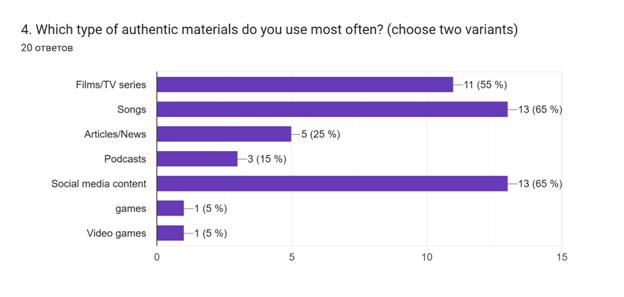
Chart 1. Types of materials
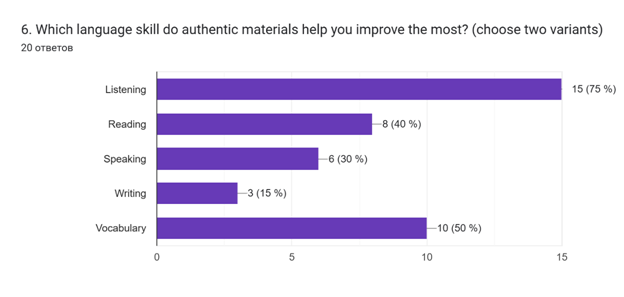
Chart 2. Language skills
Discussions
The findings highlight the central role of authentic materials in people’s lives, suggesting that learners gravitate towards more high-context input. The dominance of Listening skills and Vocabulary retention can be explained by the fact that people who use social media and listen to foreign songs tune into their audio learning, which helps to improve Listening and adjust to the natural prosody and modern slang that is perceived more easily, compared to the structured and organized audios in textbooks. In terms of vocabulary, not only the visuals, but also the frequent exposure and repetition nurture the retention of new words in their memory. The two schemes clarify and prove that language is acquired best when individuals try to understand messages slightly above their current level. Furthermore, it can be maintained that the competences are not only considered linguistic in their grammatical sense, but also sociolinguistic, as they are highly connected to the natural environment where native speakers communicate in different contexts. The choice of Social Media and Songs is therefore particularly telling because it is the content that encompasses the global scale, combining the short videos and visual cues to help the person alleviate the process of learning a new language.
Nevertheless, there are the answers provided to the open question from the survey: “ In your opinion, how can authentic materials be used more effectively in language learning?”:
“Authentic materials can be used more effectively by choosing content that matches learners’ level and goals, and by adding guidance such as pre-teaching vocabulary or providing context. Teachers can also design focused tasks (like listening for key ideas) to make the material more manageable and meaningful.”
“It can be used in various types of exercises for all skills. As much as podcasts for listening, science or magazine articles for reading, texting messages or posts, as writing and making mini podcasts in class for speaking.”
“I think it might be more effective to learn English through authentic materials if you write down all the phrases, rules, and repeat all the material afterward, so that you can practice it on your own and dig into that topic even deeper.”
These answers show that the effective and strategic use of authentic materials is as important as their content. One primary suggestion is that the acquisition process would have been much more efficient if the content had been curated to match the learners’ interests. This factor, as a matter of fact, always plays a vital role in learning a new language, as it is proven that language is acquired faster if the chosen topics are related to individuals’ preferences. Even though people tend to improve their skills much faster when the provided language content is at a slightly higher level, it is necessary to consider the pre-teaching of difficult vocabulary that will be further handled and comprehended in the context. In this way, the task of understanding the media becomes much more manageable and enjoyable. As it was noted in the second answer of the tone of the respondents, authentic materials should not be limited to improving only listening skills among all four. Regarding the proper language acquisition, all four skills - reading, listening, writing, and speaking – have to be studied and taught in an integrated way, not separately. Although listening is the most impacted in the process of using authentic materials, the other three skills help to foster overall language development. This is further emphasized by the respondent’s recommendation of actively using words, phrases, and rules encountered in authentic materials and inserting them into the practice. This ensured a profound insight into the language learning system.
Overall, the study confirms that authentic materials are a vital tool for modern English learners as they build modern language competence. Digital formats such as social media and music bridge the gap between classroom theory and real practice. While the individuals demonstrate an autonomy in using those resources, there is still a need for an efficient and beneficial integration and allocation within the formal curriculum. By providing the scaffolding and guidance, educators can create a more motivating pathway to English fluency.
References:
- Richards J. C. Curriculum Development in Language Teaching. — Cambridge: Cambridge University Press, 2001. — P. 25–35.
- Gilmore A. Authentic Materials and Authenticity in Foreign Language Learning // Language Teaching. — 2007. — Vol. 40, No. 2. — P. 97–118.
- Krashen S. The Input Hypothesis: Issues and Implications. — London: Longman, 1985. — P. 2–4.
- Peacock M. The Effect of Authentic Materials on the Motivation of EFL Learners // ELT Journal. — 1997. — Vol. 51, No. 2. — P. 144–146.
- Tomlinson B. Materials Development for Language Learning and Teaching // Language Teaching. — 2012. — Vol. 45, No. 2. — P. 150–153.
дипломов