
Статья опубликована в рамках: C Международной научно-практической конференции «Вопросы технических и физико-математических наук в свете современных исследований» (Россия, г. Новосибирск, 22 июня 2026 г.)
Наука: Математика
Секция: Математическая физика
Скачать книгу(-и): Сборник статей конференции
дипломов
GENERAL APPROACHES IN THE MECHANICS OF GROWING ELASTIC AND VISCOELASTIC BODIES

ABSTRACT
This paper presents general approaches for solving nonclassical initial-boundary value problems in the mechanics of continuously growing elastic and viscoelastic bodies. The developed formulation describes accretion processes with allowance for stress evolution, material growth, and viscoelastic effects. The original problem is reduced to a boundary value problem in terms of rate quantities, enabling the use of classical analytical and numerical methods. Applications to self-gravitating spherical bodies and layer-by-layer construction of heavy cylindrical vaults are considered. Numerical results demonstrate the significant influence of growth conditions and gravity forces on the stress–strain state and structural behavior of growing bodies.
Keywords: growing bodies; accretion mechanics; viscoelasticity; stress–strain state; nonclassical boundary value problems.
1. Introduction
The mechanics of continuously growing deformable bodies has attracted significant attention due to its applications in solid mechanics, geomechanics, biomechanics, and additive manufacturing technologies [1–4]. In such processes, new material is progressively attached to an existing body, leading to complex stress and deformation evolution that cannot be fully described by classical elasticity and viscoelasticity theories.
General formulations for growing viscoelastic bodies were developed by Manzhirov [1] and further extended in creep and viscoelastic mechanics studies by Arutyunyan and Manzhirov [2]. Applications of these approaches to accreting spherical bodies and structures formed under gravitational loading were later investigated in [3,4]. Similar problems are also encountered in micromechanics and computational modeling of evolving materials and defects [5–7]. In recent years, the rapid development of additive manufacturing technologies has further increased interest in growth mechanics and layer-by-layer fabrication processes [8].
In this work, a general approach for modeling continuously growing elastic and viscoelastic bodies is presented. The governing equations, constitutive relations, and boundary conditions describing accretion processes are formulated, and several physical and engineering applications are discussed.
2. Main Results
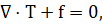
We consider the process of continuous accretion of a deformable solid body over the time interval  . For the growing body under consideration, the following relations hold: the equilibrium equation
  where
where  is the stress tensor,
  is the body-force intensity, and
  is the radius vector of a material point of the body; boundary conditions on different parts of the fixed surface are given by
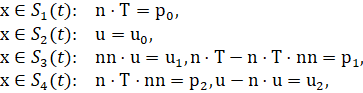
where  is the unit outward normal to the body surface and
  is the displacement vector. The initial-boundary condition on the growing surface has the form [1]

where  denotes the instant at which the particle with radius vector is attached to the body. The relation between the strain-rate tensor and the velocity field is
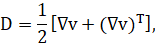
and the constitutive equation is written in the form [2]
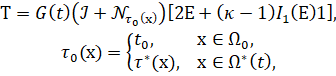
where E is the infinitesimal strain tensor, 1 is the identity tensor,  is Poisson’s ratio,
  and
and  denote the domains occupied by the initial and additional parts of the body, respectively, and
  is the loading time of the initial body.
The above relations constitute a general nonclassical initial-boundary value problem for a continuously growing body. Here,  is the stress tensor prescribed on
  and consistent with the external forces
  , while the operator
  is a linear integral operator of viscoelasticity [2]. It should be noted that, during the accretion process of an initially existing body by new material elements, the constitutive relation generally exhibits a discontinuity at the interface between the original and the additional parts of the body. As a particular case (when
  ), the constitutive equation describes a linearly elastic body.
The formulated problem can be reduced to a boundary value problem in terms of the rates of the corresponding quantities in the form [1–3]

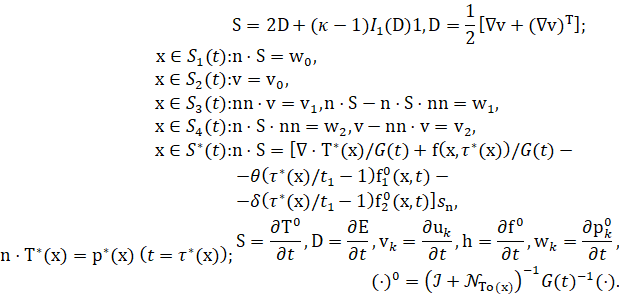
Here,  and
and  are the Heaviside and Dirac functions, respectively, sns_nsn is the normal velocity of the growing surface, and the functions
  and
and  are determined from the prescribed (known) functions of the original initial-boundary value problem.
The latter boundary value problem for the rates coincides in form with the boundary value problem of elasticity theory with time parameter  . Therefore, all known analytical and numerical methods can be employed for its solution. The solution to the original initial-boundary value problem can then be reconstructed using the decoding formulas
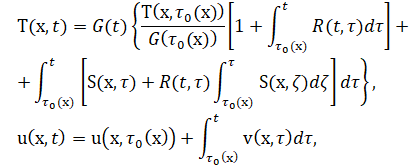
which are universal in nature and allow the true stress and strain fields to be determined at any instant of time.
Discussions of various applications of the developed theory and solutions to the corresponding problems of mechanics can be found, for example, in [3–8].
In this work, applications to self-gravitating spherical bodies formed by accretion are investigated. Closed-form solutions and numerical simulations are used to analyze the influence of growth conditions on the stress–strain state and to identify new mechanical effects associated with accretion processes.
As an engineering application, the layer-by-layer construction of a heavy cylindrical vault under gravity loading is studied. The effects of gravity, prestressed elements, and temporary local support on the evolution of the stress–strain state are analyzed.
The exceptional importance of accounting for gravity forces acting throughout the entire construction process when evaluating the strength, stability, and load-bearing capacity of the final structure is demonstrated. The possibility of highly efficient control of both the transient and final states of a heavy body manufactured by accretion is shown through the creation of nonzero initial stresses in the attached additional material, as well as through temporary local loading of the body surface.
3. Conclusion
This paper presented a general approach for solving nonclassical initial-boundary value problems in the mechanics of continuously growing elastic and viscoelastic bodies. The developed formulation describes accretion processes and allows the application of classical analytical and numerical methods through a rate-based approach.
Applications to self-gravitating bodies and layer-by-layer construction under gravitational loading demonstrated the strong influence of growth conditions, gravity forces, and initial stresses on the stress–strain state of growing structures. The proposed theory can be effectively applied to problems in solid mechanics and additive manufacturing technologies.
References:
- Manzhirov, A. V. (1995). General quasistatic initial-boundary value problem for a piecewise-continuously growing viscoelastic aging body. Journal of Applied Mathematics and Mechanics, 59(5), 836–848.
- Arutyunyan, N. Kh., & Manzhirov, A. V. (1999). Contact Problems of Creep Theory. Yerevan: NAS RA Publishers.
- Manzhirov, A. V., & Parshin, D. A. (2006). Accretion of a viscoelastic sphere in a centrally symmetric force field. Mechanics of Solids, 41(1), 66–83.
- Manzhirov, A. V., & Parshin, D. A. (2015). Construction of an arch structure using additive technology under gravity loading. Mechanics of Solids, 50(5), 94–107.
- Ambati, M., Gerasimov, T., & De Lorenzis, L. (2015). A review on phase-field models of brittle fracture and a new fast hybrid formulation. Computational Mechanics, 55(2), 383–405.
- Mura, T. (1987). Micromechanics of Defects in Solids (2nd ed.). Dordrecht: Martinus Nijhoff Publishers.
- Zohdi, T. I., & Wriggers, P. (2008). An Introduction to Computational Micromechanics. Berlin: Springer.
- Gibson, I., Rosen, D. W., & Stucker, B. (2015). Additive Manufacturing Technologies: 3D Printing, Rapid Prototyping, and Direct Digital Manufacturing (2nd ed.). New York: Springer.
дипломов