
Статья опубликована в рамках: Научного журнала «Студенческий» № 15(353)
Рубрика журнала: Педагогика
Скачать книгу(-и): скачать журнал часть 1, скачать журнал часть 2, скачать журнал часть 3, скачать журнал часть 4, скачать журнал часть 5, скачать журнал часть 6
FORMATION OF SELF-SERVICE SKILLS IN CHILDREN AND ADOLESCENTS WITH SEVERE MULTIPLE DEVELOPMENTAL DISABILITIES

ABSTRACT
The article is devoted to the problem of the formation of social and household skills in children with severe multiple developmental disabilities. The article examines the relevance of planning the educational environment in such a way that children of this category can adapt socially. Based on the experience of Russian authors, a methodology was applied to assess the degree of independence of a child according to several indicators. Diagnosis shows that, depending on the severity of the disorders, proportional adult involvement in the child's life is necessary.
Keywords: correctional and developmental work, formation of household skills, children with TMNR.
The inclusion of children and adolescents with severe multiple developmental disabilities in the educational environment allows them to realize the right to education, but at the same time opens up a number of nuances. One of these is the problem of children's household adaptation.
The formation of household skills plays an important role in the life of a child with special needs. Satisfaction of basic life needs, possession of basic skills and abilities that in later life will allow for the exercise of domestic independence is the main goal and objective of teaching children with TMNR. When we teach a child to eat, dress, and take care of himself on his own, we help him become more independent, learn new things about himself and the world around him.
Let's say few people know that the ability to hold a spoon, control and maneuver it favorably affects the formation of arbitrary hand movements, which will later be used in writing; the ability to dress is directly related to orientation on one's own body and the training of arbitrary movements of arms and legs, which affects coordination and fine motor skills; eating a variety of foods of different consistency trains the motor capabilities of the speech apparatus, etc. Therefore, the formation of basic skills in children with TMD should be the subject of special attention and care both in institutions and in the family.
The role of the formation of social and household skills in the lives of children with TMNR is noted in the works of Russian authors of methodological developments in correctional psychology. I.A. Filatov and E.V. Karakulova contributed to the development of recommendations for teachers on the use of technologies for social and communicative rehabilitation of children with severe and multiple developmental disabilities.
If we consider in the field of defectology, V.A. Shinkarenko dealt with the problem of instilling social and household skills to students with TMNR at the primary education level. He developed a methodology for teaching social adaptation using diagnostic tables. With their help, it is possible to determine how much skills are formed in children of this category.
In the course of the study, we studied a small group of children with TMNR. Girl I. (7 years old).
Physical development: moved independently, made turns, tilts, sat on a chair without the help of an adult.
Emotional sphere: reacted to the emotions of the caregiver, emotional response to the situation.
Leading hand: right.
Grabbing and holding objects: correct.
Eye appearance: strabismus.
Hearing: responds to requests and intonation of speech, performs with repeated repetition.
Boy A. (10 years old).
Physical development: moves on tiptoe, can independently sit on a chair, bend over.
Emotional sphere: reacts to the voice, emotions and intonation of an adult.
Emotional response: present.
The leading hand is the right. Grabbing and holding objects with the help of an adult. A small object holds well, a large object holds with two hands, shifts from one to the other.
Eye appearance: correct.
Hearing: responds to and fulfills requests.
The girl is M. (9 years old).
Physical development: moves in a crouch, requires support from an adult, turns and bends over, sits on a chair independently.
Emotional sphere: there is a reaction to the emotions of the caregiver, shows responses.
Emotional background: positive. From an overabundance of feelings, he may cry and then laugh.
Leading hand: left. She performed all the actions with her left hand, and with her right hand she could hardly grab and hold an object.
Eye appearance: strabismus.
Hearing: reacted to the intonation of speech, repeated repetition was required to fulfill requests.
The studied group has a combination of disorders of profound intellectual underdevelopment with various sensory and motor developmental disorders of varying severity. In the course of the study, V.A. Shinkorenko's methodology was applied to assess the level of self-service skill formation, namely, according to the principle of assistance: all actions are performed by adults; joint performance is possible; partial independent; continuous performance without the help of an adult. Figure 1 below shows the results of the diagnosis of self-care skills in children with TMNR according to various indicators (hygiene procedures, dressing/undressing, eating) according to the principle of involvement of outside help in percentage terms.
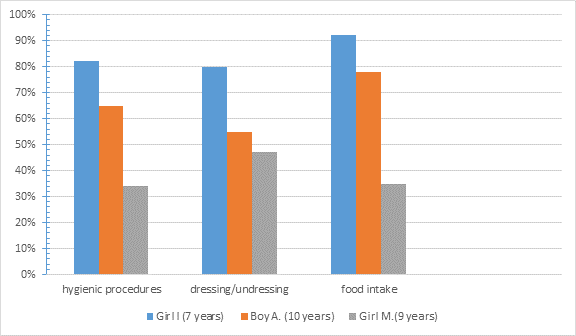
Figure 1. The level of self-service skills
From this study, it can be concluded that adult help is not completely excluded from the lives of children with TMNR. The development of self-service skills in children with severe multiple developmental disabilities is a long and uneven process. The mechanism of learning self-care skills is significantly slower compared to children with normal development. Sometimes, elementary actions are very difficult. An adult's eagerness to do everything for a child only makes the situation worse. Concern for the well-being of the child should be expressed in the desire to create conditions in which it will be possible to master all the necessary skills independently.
References:
- Vygotsky, L.S. Child psychology. Moscow: VLADOS, 2013. 435 p.
- Filatova, I.A., Karakulova, E.V. Technologies of social and communicative rehabilitation and habilitation of children with severe and multiple developmental disabilities: a methodological guide/ Ural State Pedagogical University. Yekaterinburg, 2019, 134 p.
- Shinkarenko, V.A. Diagnostics and formation of self-service, household and manual labor skills in mentally handicapped children: methodological materials to help teachers of special institutions and parents. Minsk: BelAPDI Publishing House – "Open Doors", 1997.
- Zinatullina Alla Rashitovna FORMATION OF SOCIAL AND HOUSEHOLD SKILLS IN CHILDREN WITH INTELLECTUAL DISABILITIES IN THE PROCESS OF CORRECTIONAL AND DEVELOPMENTAL WORK // Bulletin of KazGUKI. 2023. No. 2. URL: https://cyberleninka.ru/article/n/formirovanie-sotsialno-bytovyh-navykov-u-detey-s-narusheniem-intellektualnogo-razvitiya-v-protsesse-korrektsionno-razvivayuschey (date of request: 11/12/2025).
- Shinkarenko, V.A., Eskevich, D.N. Organization of labor training for students of the second department of an auxiliary school. - Minsk, 2008. - 49 p.