
Статья опубликована в рамках: XCIX Международной научно-практической конференции «Вопросы технических и физико-математических наук в свете современных исследований» (Россия, г. Новосибирск, 25 мая 2026 г.)
Наука: Математика
Секция: Математическая физика
Скачать книгу(-и): Сборник статей конференции
дипломов
APPLICATION OF THE FAST EXPANSION METHOD IN THE ANALYSIS OF PROBLEMS FOR THE NAVIER–STOKES EQUATIONS

ABSTRACT
This paper presents the application of the fast expansion method to boundary value problems for the Navier–Stokes equations describing incompressible viscous flow in a curved pipe of finite length. The method provides analytical approximate solutions, enabling detailed analysis of velocity behaviour within the domain. It ensures convergence and allows estimation of approximation errors, including deviations in both boundary conditions and governing equations. By transforming the original nonlinear partial differential system into a closed system of ordinary differential equations, the approach simplifies the analysis. The results demonstrate its effectiveness in studying the accuracy, existence, and uniqueness of solutions for nonlinear fluid flow problems.
Keywords: fast expansion method; Navier–Stokes equations; incompressible viscous fluid; curved pipe flow; analytical approximation.
1. Introduction
The study of viscous fluid motion governed by the Navier–Stokes equations remain a fundamental problem in fluid mechanics due to its wide range of applications. Although numerous analytical and numerical methods have been developed [2–4], the nonlinear nature of these equations still poses significant challenges, particularly in achieving accurate solutions that satisfy both governing equations and boundary conditions.
Classical approaches, such as finite element and spectral methods [3,5–7], are widely used but often rely on discretisation or truncated approximations, which may introduce considerable errors. Moreover, the accuracy of boundary conditions and residuals is not always explicitly evaluated, limiting solution reliability.
To address these issues, the fast expansion method [1] offers an analytical approximation framework with proven convergence and error estimation capabilities. In this paper, the method is applied to the flow of an incompressible viscous fluid in a curved pipe. By reducing the original nonlinear system to a closed system of ordinary differential equations, the approach simplifies the analysis while enabling investigation of the accuracy, existence, and uniqueness of solutions.
2. Main Results
Solutions of boundary value problems for the Navier–Stokes equations have always attracted special attention. In this context, there is a growing interest in methods capable of overcoming the nonlinear aspects of the problem. In such cases, numerical methods, the small parameter method, or other analytical approaches are typically employed. However, known approximate solutions have several drawbacks: both the boundary conditions and the governing differential equations of motion are satisfied only approximately; there is no analysis of the error in satisfying these boundary conditions and the Navier–Stokes equations, which may be significant due to the necessity of computing higher-order derivatives in nonlinear expressions.
In this regard, it is proposed to use the fast expansion method.
The fundamentals of this method are presented in [1]. The advantages of the fast expansion method are as follows:
– the obtained approximate solution has an analytical form, which allows investigation of the behaviour of unknown functions at every point of the domain under consideration;
– convergence of the method has been proven;
– An estimate of the method’s error is provided.
The method also makes it possible to analyse the error in satisfying the boundary conditions. It is possible to accurately determine the residual of the differential equations of motion. Such a residual indicates how accurately the physical laws underlying the model of a continuous medium (viscous fluid) are taken into account.
To demonstrate the capabilities of the fast expansion method, consider the problem of motion of an incompressible viscous fluid in a curved pipe of finite size.
The boundary of the domain  of a curved pipe is determined by the inequalities:

 (1)
(1)
The par ameters  are assumed to be given, where
  is an integer. The functions defining the lower and upper boundaries
  may also be given by other smooth functions; all subsequent considerations remain valid in this case. The pipe is bounded on the left and right by the planes
  and
and  .
.
The velocity components of fluid particles are denoted by  , where
  is the kinematic viscosity, introduced for convenience in further calculations.
The boundary conditions are written as the no-slip condition on the upper and lower walls of the planar pipe:

At the inlet and outlet of the pipe, for simplicity, the velocity profiles are specified according to the same Poiseuille law:

The boundary conditions (2) and (3) are consistent at the corners of the domain , which is important for constructing a smooth solution without discontinuities.
For the pressure, a condition is specified only at one point of , for example, at the lower left corner of the pipe:

Technically, implementing a Poiseuille velocity distribution at both the inlet and outlet is difficult; however, mathematically, there is no contradiction: at  and
and  , the velocity components
  may be given by arbitrary smooth functions satisfying mass conservation. If the pipe is sufficiently long,
 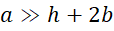 , then at some distance from the inlet and outlet, in the central part of the pipe, the velocity distribution weakly depends on the boundary conditions and approaches the Poiseuille profile.
The Navier-Stokes equations for incompressible fluid motion are written as:
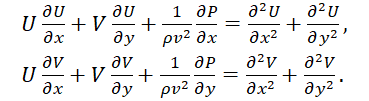 (5)
(5)
By cross-differentiation of (5), the pressure  is eliminated:

This is supplemented by the incompressibility equation:

Thus, we obtain a system of two equations (6), (7) with two unknowns .
Mathematically, the problem is formulated as follows: in the class of smooth functions 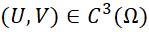 , Find a solution of the differential system (6), (7) satisfying boundary conditions (2), (3). After determining , the pressure is obtained from system (5) with boundary condition (4).
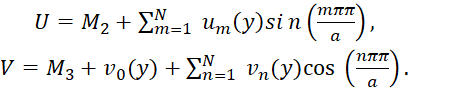
The solution will be constructed using the fast expansion method. Analysing equation (6), one can observe that the highest-order derivative of  with respect to
  is second-order, while for
  it is third-order. Therefore, the velocity components are represented as fast expansions in the variable over the interval
 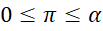 :
:
 (8)
(8)
where:
 (9)
(9)
After substituting (8) and (9) into equations (6) and (7), we obtain a closed system of ordinary differential equations with respect to  unknown functions depending only on the variable
  :
:

The explicit form of this nonlinear system and its solution will be presented in subsequent works. The application of the fast expansion method, in addition to the advantages mentioned above, also allows a detailed discussion of the issues of existence and uniqueness of the solution.
3. Conclusion
This paper demonstrates the application of the fast expansion method to boundary value problems for the Navier–Stokes equations describing incompressible viscous flow in a curved pipe. The approach transforms the original nonlinear partial differential system into a closed system of ordinary differential equations, simplifying the analysis. The method provides explicit analytical approximations, ensures convergence, and enables error estimation, including deviations in boundary conditions and governing equations. These features improve the reliability of the results compared to conventional techniques. Overall, the fast expansion method proves to be an effective tool for nonlinear fluid flow problems and offers a foundation for studying solution existence and uniqueness. Future work will focus on explicit solutions, improved algorithms, and extensions to more complex geometries.
References:
- Chernyshov, A. D. (2014). Fast expansion method for solving nonlinear differential equations. Computational Mathematics and Mathematical Physics, 54(1), 13–24.
- Temam, R. (2001). Navier–Stokes Equations: Theory and Numerical Analysis. American Mathematical Society.
- Girault, V., & Raviart, P.-A. (2012). Finite Element Methods for Navier–Stokes Equations: Theory and Algorithms. Springer.
- Gresho, P. M., & Sani, R. L. (2013). Incompressible Flow and the Finite Element Method. Wiley.
- Canuto, C., Hussaini, M. Y., Quarteroni, A., & Zang, T. A. (2011). Spectral Methods: Fundamentals in Single Domains. Springer.
- Boyd, J. P. (2013). Chebyshev and Fourier Spectral Methods. Dover Publications.
- Karniadakis, G. E., & Sherwin, S. J. (2013). Spectral/hp Element Methods for Computational Fluid Dynamics. Oxford University Press.
дипломов