Статья опубликована в рамках: XCIX Международной научно-практической конференции «Вопросы технических и физико-математических наук в свете современных исследований» (Россия, г. Новосибирск, 25 мая 2026 г.)
Наука: Математика
Секция: Математическая физика
Скачать книгу(-и): Сборник статей конференции
дипломов
MATHEMATICAL MODELING OF THE VELOCITY FIELD OF DISPLACEMENTS FOR A HALF-SPACE WITH A CYLINDRICAL CAVITY

ABSTRACT
This paper presents a mathematical model of the displacement velocity field in a half-space composed of a cohesive granular material containing a cylindrical cavity. The problem is formulated under axisymmetric conditions in a cylindrical coordinate system, assuming that all stress, strain, and displacement components depend only on the radial coordinate. The governing equations include equilibrium equations, a plasticity condition, and an associated flow rule, which together form a closed system. A third-order ordinary differential equation for the radial displacement velocity is derived. An approximate analytical solution is obtained using a Taylor series expansion up to third-order terms. The resulting expression describes the radial component of the displacement velocity under plane strain conditions and accounts for microstructural effects. The proposed model provides insight into the mechanical behavior of granular media with cavities and can be applied to engineering problems involving stability and deformation of such materials.
Keywords: granular material; cylindrical cavity; displacement velocity; plasticity; mathematical modeling.
1. Introduction
The mechanical behavior of granular and porous materials with cavities is of significant importance in geomechanics and structural engineering, particularly in problems related to underground constructions and stability analysis. Classical plasticity theory provides a fundamental framework for describing stress–strain behavior under limiting conditions and has been widely applied in continuum mechanics [4–6].
In recent years, advanced models incorporating microstructural effects, such as micropolar and microcontinuum theories, have been developed to better describe materials with internal structure and voids [7,8]. These approaches improve the accuracy of stress and deformation analysis near discontinuities.
Axisymmetric problems involving cylindrical cavities in granular media have been investigated in several studies, highlighting the influence of cavities on stress distribution and deformation patterns [1,2]. The use of associated flow rules enables the formulation of closed governing equations for such problems [3].
This paper aims to develop a mathematical model of the displacement velocity field in a half-space with a cylindrical cavity. A third-order differential equation is derived and approximately solved using a Taylor series expansion.
2. Main Results
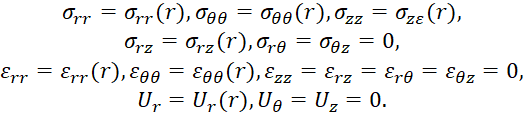
An axisymmetric stress-strain state of a compressed granular material with a cylindrical cavity is considered in a cylindrical coordinate system. It is assumed that stresses, strain rates, and displacement velocities depend only on the radial coordinate  :
:
Taking into account the above assumptions, the equilibrium equations take the form [1]:
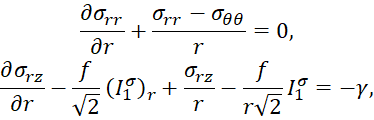
where  is the rolling friction coefficient, and
  is the gravitational force.
The plasticity condition is given by [2]:

Where  is cohesion, and
  is the internal friction coefficient.
The system of equations in stresses, consisting of two equilibrium equations and the plasticity condition, is not closed for four stress components. To close the system, we use the associated flow rule [3]:
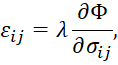
where  is an undetermined Lagrange multiplier.
The components of the strain tensor are [1]:
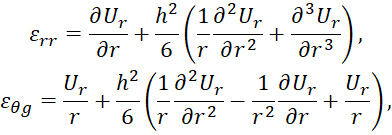
where  is the characteristic size of the microstructure.
From the associated flow rule, we obtain:
 ,
,
 , (1)
, (1)
 .
.
The third and fourth equations of system (1) serve to close the system of stress equations.
From the second equation of (1), we express :

Substituting this expression into the first equation of (1), we obtain:

This leads to the third-order ordinary ditterential equation:

where 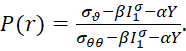
Equation (2) is a third-order ordinary differential equation. Its solution is obtained using a Taylor series expansion. Retaining terms up to third order, we obtain:
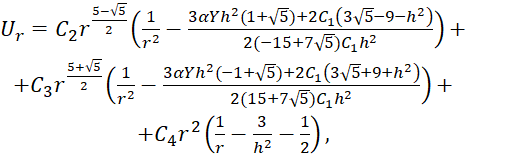 (3)
(3)
where 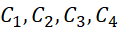 are integration constants (full coefficients retained as in the original formulation).
Expression (3) represents the radial component of the displacement velocity for a half-space composed of a cohesive granular material with a cylindrical cavity under plane strain conditions.
- Conclusion
In this study, a mathematical model for the displacement velocity field in a half-space with a cylindrical cavity composed of a cohesive granular material has been developed. Under axisymmetric assumptions, the governing equations were formulated based on equilibrium conditions, a plasticity criterion, and an associated flow rule, leading to a closed system. A third-order ordinary differential equation describing the radial displacement velocity was derived and approximately solved using a Taylor series expansion.
The obtained analytical expression provides insight into the influence of microstructural parameters and material properties on the deformation behaviour near the cavity. The proposed approach extends classical formulations by incorporating microstructural effects and offers a relatively simple framework for analysing such problems.
The results can be applied to practical engineering problems involving granular media with cavities, such as geotechnical stability and underground structures. Future work may focus on improving the accuracy of the solution and extending the model to more complex loading conditions and geometries.
References:
- Verveyko, N. D., & Frolova, O. A. (2015). Limit axisymmetric stress state of compressed granular material with a cylindrical cavity. Vestnik Chuvash State Pedagogical University. Series: Mechanics of Limit State, 3(25), 29–36.
- Valyukhov, S. G., Verveyko, N. D., & Smotrova, O. A. (1999). Micropolar Model of Cohesive Granular Materials. Voronezh: Voronezh State University.
- Bykovtsev, G. I., & Ivlev, D. D. (1998). Theory of Plasticity. Vladivostok: Dalnauka.
- Chen, W. F., & Han, D. J. (1988). Plasticity for Structural Engineers. New York: Springer.
- Hill, R. (1950). The Mathematical Theory of Plasticity. Oxford: Oxford University Press.
- Drucker, D. C., & Prager, W. (1952). Soil mechanics and plastic analysis for limit design. Quarterly of Applied Mathematics, 10(2), 157–165.
- Cowin, S. C., & Nunziato, J. W. (1983). Linear elastic materials with voids. Journal of Elasticity, 13(2), 125–147.
- Eringen, A. C. (1999). Microcontinuum Field Theories: I. Foundations and Solids. New York: Springer.
дипломов