
Статья опубликована в рамках: XCIX Международной научно-практической конференции «Вопросы технических и физико-математических наук в свете современных исследований» (Россия, г. Новосибирск, 25 мая 2026 г.)
Наука: Математика
Секция: Математическая физика
Скачать книгу(-и): Сборник статей конференции
дипломов
ON A CLASS OF DUAL PROBLEMS IN PLASTICITY THEORY

ABSTRACT
This paper investigates a class of dual problems in plasticity theory based on alternative interpretations of governing equations. For plane deformation, the introduction of a vector potential enables a more symmetric formulation and facilitates the construction of dual problems by interchanging displacement and potential fields. The conditions under which the dual formulation preserves the structure of the original system are established, particularly for incompressible media, along with constraints ensuring invariance under rigid-body motions. The approach is applied to ideal plasticity, demonstrating that the dual problem satisfies key physical conditions and confirming the effectiveness of the duality concept.
Keywords: duality; plasticity theory; vector potential; incompressible media; plane deformation.
1. Introduction
The study of plane deformation problems in elasticity and plasticity plays an important role in continuum mechanics. Classical formulations are typically expressed in terms of stress and displacement fields, leading to systems of differential equations describing equilibrium and material behavior. Early works on conjugate and dual problems demonstrated that the same physical process can admit alternative mathematical interpretations, providing additional analytical tools for solving complex problems [1,11].
Further developments in the mechanics of granular and inelastic media, as well as in the theory of ideally hardening materials, have revealed structural properties of governing equations that support such alternative formulations [2,5,6]. The introduction of auxiliary functions, including vector potentials, has proven effective in simplifying the mathematical structure and enabling new interpretations of deformation processes [9,10].
In applied contexts, dual approaches have been used in problems of rock fragmentation, brittle fracture, and invariant properties of stress–strain states, highlighting their practical significance [3,4,7,8]. However, despite these advances, the potential of dual formulations in plasticity theory remains insufficiently explored.
This paper aims to investigate a class of dual problems in plasticity theory based on alternative interpretations of governing equations, with particular attention to plane deformation and incompressible media.
2. Main Results
It is well known that the method of analogies plays a significant role in mechanics. It often happens that two different processes are described by the same system of equations. Clearly, once a solution to such a system is obtained for one process, the solution for the other process is immediately available as well.
Problems of duality, or conjugate problems [1], can also be attributed to this class. Unlike analogies, here the equations refer to the same physical process, for example, the deformation of a solid body. In some cases, the system of equations can be written in such a way that the unknown variables admit a new interpretation, alternative to the original one. Then the constructed solution can be treated as a solution to two problems: the original problem and a new one that is dual to it. Let us consider two examples.
First Example
Assume that the deformation is plane, and inertial and body forces can be neglected. Then, for a wide class of deformable media, the following equations hold:
 (1)
(1)
 (2)
(2)
where  and
and  are the components of stresses and displacements (or their increments),
  , and the coefficients
  are given.
The formulation (1), (2) is classical. However, in many respects, it is "pathological" [2]. For example, five first-order differential equations reduce to a single fourth-order equation. A more natural formulation can be obtained by introducing, instead of the stress field, a vector field  , which is the vector potential of the stress field:


 ,
,
 . (4)
. (4)
The system is written with respect to two vector fields  and
and  . Suppose a solution has been obtained. The main idea is to interchange the roles of the vectors
  and
and  : associate with the stress field and with the displacement field of the dual problem. This is possible only if and enter the system symmetrically. Therefore, we restrict ourselves to incompressible media:

 (5)
(5)
where the coefficients  ,...,
,...,  are given. Introduce dual variables (denoted with a tilde):

The system retains its structure and becomes:


 (6)
(6)
The equations of the dual problem must be invariant under rigid-body rotation. Therefore, the righthand side of (6) must not depend on the rotor of the vector  , i.e.,

Hence,  . This is a reasonable restriction, meaning that hydrostatic compression does not affect the maximum shear or the orientation of principal stresses.
Second Example
Consider the model of ideal plasticity:

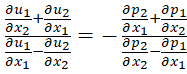 .
.
Here  are velocity components, and
  is the yield stress.
For the dual problem:

Thus, in the dual problem, the conditions of incompressibility, coaxiality, and constant shear rate throughout the deformation domain are satisfied.
The last condition is key to problems of optimal fragmentation of rocks under explosive action [3,4]. In [5,6], the condition of constant maximum shear rate was studied within theories of ideally hardening media using duality with respect to the equations of ideal plasticity. In [7,8], this model was investigated in connection with brittle fracture problems.
3. Conclusion
This paper examines a class of dual problems in plasticity theory based on alternative interpretations of governing equations. For plane deformation, the introduction of a vector potential enables a more symmetric formulation and supports the construction of dual problems by interchanging displacement and potential fields. It is shown that the dual transformation preserves the structure of the equations under specific conditions, particularly for incompressible media, with additional constraints arising from invariance under rigid-body motions. The approach is applied to ideal plasticity, where the dual problem satisfies key conditions such as incompressibility, coaxiality, and constant shear rate. These results confirm the effectiveness of the duality approach and highlight its potential for further applications in continuum mechanics.
References:
- Hill, R. (1956). On conjugate pairs of plane problems in elasticity theory. Mechanics, No. 6, pp. 71–79.
- Revuzhenko, A. F. (1981). On the deformation of granular media. Part 2: Investigation of a plane model. Journal of Mining Science (FTPRPI), No. 5, pp. 3–13.
- Kuznetsov, V. M., & Sher, E. N. (1976). Principle of uniform fragmentation of solids under explosion. Doklady of the USSR Academy of Sciences, Vol. 226, No. 2.
- Sher, E. N., & Chernikov, A. G. (1989). On the shear method of uniform fragmentation of rock under explosion. Journal of Mining Science (FTPRPI), No. 6, pp. 20–23.
- Ivlev, D. D. (1960). On the theory of ideally hardening media. Doklady of the USSR Academy of Sciences, Vol. 130, No. 4, pp. 742–745.
- Artemov, M. A., & Ivlev, D. D. (1997). On the theory of ideally hardening media. Doklady of the Russian Academy of Sciences, Vol. 355, No. 5, pp. 623–625.
- Shemyakin, E. I. (1997). On brittle fracture of solids (plane deformation). Mechanics of Solids, No. 2, pp. 145–150.
- Shemyakin, E. I. (2000). On invariants of stress and strain states in mathematical models of continuum mechanics. Doklady of the Russian Academy of Sciences, Vol. 373, No. 5, pp. 632–634.
- Lavrikov, S. V., Mikenina, O. A., & Revuzhenko, A. F. (2009). Description of plane deformation of inelastic bodies using the vector of internal forces and non-Archimedean mathematical analysis. Bulletin of Yakovlev Chuvash State Pedagogical University. Series: Limit State Mechanics, No. 1, pp. 160–171.
- Ivlev, D. D. (2002). On the theory of differential correspondences in continuum mechanics. In: Mechanics of Plastic Media, Vol. 2. Moscow: Fizmatlit, 448 p.
- Prager, W. (1956). On conjugate states of plane deformation. Mechanics, No. 6, pp. 87–90.
дипломов