
Статья опубликована в рамках: XCIX Международной научно-практической конференции «Вопросы технических и физико-математических наук в свете современных исследований» (Россия, г. Новосибирск, 25 мая 2026 г.)
Наука: Математика
Секция: Математическая физика
Скачать книгу(-и): Сборник статей конференции
дипломов
QUASI-STATIC BEHAVIOR OF A CANTILEVER ROD LOADED WITH TWO CONCENTRATED FORCES

ABSTRACT
This paper studies the quasi-static behaviour of a cantilever rod fixed by a viscoelastic support and subjected to two concentrated forces. The governing equation of motion and the corresponding static equation are formulated. Both physically linear and nonlinear models are considered. For the linear case, equilibrium states are described by a transcendental equation, and a parametric form of the statically singular curve is obtained. It is shown that multiple solution branches may exist, with some lacking physical meaning. The domain of existence of quasi-static processes is determined in the parameter space. For the nonlinear model, higher-order terms lead to more complex behaviour, and the influence of initial conditions is analysed through domains of attraction.
Keywords: quasi-static behaviour; cantilever rod; concentrated forces; singular curve; stability analysis.
1. Introduction
The stability and deformation of rod-like structures are fundamental problems in structural mechanics with broad engineering applications. Classical studies established the theoretical basis for analysing the equilibrium and stability of elastic systems [1,2].
Recent research has focused on rods under complex loading and nonlinear effects, revealing multiple equilibrium configurations and sensitivity to system parameters [3,4]. The influence of material nonlinearity and variable stiffness has also been investigated, showing significant deviations from classical behaviour [5]. In addition, modern methods for determining critical loads and stability thresholds, together with studies on dynamic effects, have further advanced the understanding of rod behaviour [6,7]. However, the quasi-static response of rods subjected to multiple concentrated forces, particularly with viscoelastic constraints, remains insufficiently explored. Issues such as the existence of multiple equilibrium states, statically singular curves, and dependence on initial conditions require further study.
In this paper, we investigate the quasi-static behaviour of a cantilever rod fixed by a viscoelastic support and loaded by two concentrated forces. Both linear and nonlinear models are analysed, with emphasis on equilibrium solutions, singular curves, and domains of existence of quasi-static processes.
2. Main Results
Let us consider the problem of the quasi-static behaviour of a rod fixed at one end by means of a viscoelastic connection with a support, and at the other end loaded by concentrated forces  as shown in Fig. 1.
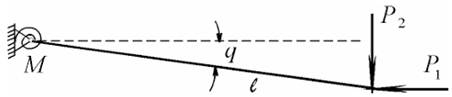
Fig. 1.
The equation describing the motion of the rod is written in the following form:

where 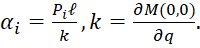 Equation (1), for
  const, admits a solution
  const, which determines the equilibrium position and is a solution of the static equation:

Let us consider two cases.
(a) Physically linear model
That is,
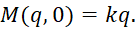 (3)
(3)
Then the static equation (2) takes the form:

In Fig. 2, a qualitative graph of the dependence of  on
on  , corresponding to equation (4), is presented. For
  , the surface becomes multi-sheeted. As a result of intersecting such a surface with the plane
  const, curves are obtained whose points corresponding to part ABC do not have physical meaning.
The static criterion [2] in this case has the form:

From equations (4) and (5), we obtain that:
 (6)
(6)
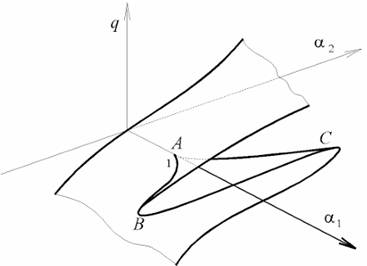
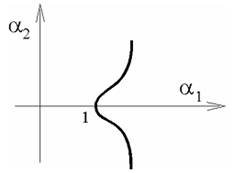
Fig. 2. Fig. 3.
Relations (6) represent a parametric definition of a curve in the plane ( ). In Fig. 3, a qualitative graph of this statically singular curve is presented. From Fig. 2 and Fig. 3, it follows that to the left of the statically singular curve, there exists a quasi-static process of one type, and to the right, of two types, corresponding to each sheet of the surface shown in Fig. 2. The possibility of realising each of these two processes depends on the values of the initial conditions  and
and  . The surface ABC is the boundary separating the domains of attraction corresponding to the other two sheets when
  . Consequently, the domain of existence of the quasi-static process is any region in the plane ( ) that does not contain points of the singular curve shown in Fig. 3. For a loading trajectory intersecting the singular curve shown in Fig. 3, quasi-static deformation of the system under consideration is possible; however, in this case (as follows from Fig. 2), it is necessary to impose restrictions on the initial conditions. To determine these restrictions, it is required to construct the domains of attraction.
(b) Physically nonlinear model
Let, for example,

The static equation (2) takes the form:

In Fig. 4, a qualitative graph of the dependence  , corresponding to relation (8), is presented for
  , and
, and  . It is obvious that not all sheets of the surface have physical meaning; therefore, in Fig. 4, only those parts are shown whose points have physical meaning (this is verified by cross-sections).
The part of the surface for  will be symmetric with respect to the
  -axis.
The static criterion in this case has the form:

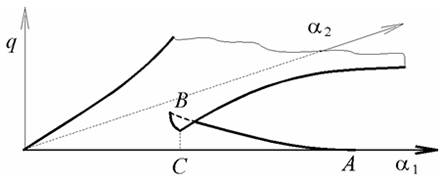
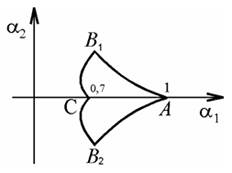
Fig. 4. Fig. 5.
In Fig. 5, a qualitative graph of the statically singular curve in the plane  ), corresponding to equations (8), (9), is presented for
  . From Fig. 4 and Fig. 5, it follows that any region
  that does not contain points of the determinant curve (Fig. 5) is a domain of existence of quasi-static deformation of the system under consideration. In this case as well, studying the possibility of quasi-static deformation along a trajectory intersecting the statically singular curves (Fig. 5) leads to determining the domains of attraction corresponding to each sheet of surface (8).
3. Conclusion
This paper investigates the quasi-static behaviour of a cantilever rod with a viscoelastic support under two concentrated forces. Governing and static equations are derived for both linear and nonlinear models. In the linear case, equilibrium states are described by a transcendental equation, and statically singular curves are obtained, revealing multiple solution branches with limited physical relevance. The domain of quasi-static processes is determined in the parameter space. For the nonlinear model, higher-order terms lead to more complex behaviour and modified stability conditions. The results highlight the role of singular curves and initial conditions in quasi-static deformation and provide a basis for further studies of nonlinear rod systems.
References:
- Rabotnov, Y. N. (1979). Mechanics of Deformable Solids. Moscow: Nauka.
- Elsgolts, L. E. (1969). Differential Equations and the Calculus of Variations. Moscow: Nauka.
- Blostotsky, B. V. (2021). Tensile buckling of a rod with an end moving along a circular guide. Applied Sciences, 11(16), 7277. https://doi.org/10.3390/app11167277
- Almet, A. A., et al. (2018). Post-buckling behaviour of a growing elastic rod. Proceedings of the Royal Society A, 474(2213).
- Brailovski, V., et al. (2016). Ti–Ni rods with variable stiffness for spine stabilisation. Biomechanics and Modelling in Mechanobiology, 15(3), 615–627. https://doi.org/10.1007/s40830-016-0053-4
- Marcinowski, J., & Sadowski, M. (2024). Application of the Southwell method to determine the critical load of compression rods made of nonlinear materials. Civil and Environmental Engineering Reports, 34(4), 168–184.
- Koutsogiannakis, P. (2023). Stabilisation and dynamic behaviour of elastic rods under external excitation. Journal of the Mechanics and Physics of Solids, 175, 105–120.
дипломов