Статья опубликована в рамках: XCIX Международной научно-практической конференции «Вопросы технических и физико-математических наук в свете современных исследований» (Россия, г. Новосибирск, 25 мая 2026 г.)
Наука: Математика
Секция: Математическая физика
Скачать книгу(-и): Сборник статей конференции
дипломов
ELASTIC–PLASTIC TORSION OF A CIRCULAR CYLINDER IN THE CASE OF HILL-TYPE ANISOTROPY

ABSTRACT
This paper studies the elastic–plastic torsion of a circular cylinder in the case of Hill-type anisotropy. The governing equations are formulated using the equilibrium equation, strain–displacement relations, Hooke’s law in the elastic region, and the associated flow rule in the plastic region. The problem is solved by the perturbation method, where the solution is constructed as an expansion in a small parameter. The zeroth approximation corresponds to the classical isotropic solution, while the first approximation provides expressions for stress components, displacement fields, and the elastic–plastic boundary. The results describe the stress and displacement fields of the cylinder under anisotropic torsion.
Keywords: elastic–plastic torsion; circular cylinder; Hill-type anisotropy; perturbation method; stress; displacement.
1. Introduction
The elastic–plastic torsion of cylindrical bodies is an important problem in solid mechanics. Previous studies [1,2] investigated the stress–strain state of plastically anisotropic circular cylinders and thick-walled tubes, mainly in the case of translational anisotropy.
In this paper, the torsion of a circular cylinder is analysed within the framework of Hill-type anisotropy. The material in the plastic region is assumed to satisfy an anisotropic yield condition [3]. The formulation is based on the equilibrium equation, Cauchy strain–displacement relations, and Hooke’s law in the elastic region, together with the associated flow rule in the plastic region.
The problem is solved using the perturbation method [4], where all unknown quantities are expanded in terms of a small parameter. The zeroth approximation corresponds to the classical isotropic solution [6], while the first approximation accounts for anisotropic effects, following approaches similar to [5,7].
The study aims to determine the stress distribution, displacement field, and elastic–plastic boundary for a circular cylinder under torsion with Hill-type anisotropy.
2. Main Results
Following [1], we consider a circular cylinder with outer radius  and inner radius
  . The cylinder is in a state of elastic-plastic torsion, and in the plastic zone, the material is assumed to be anisotropic with the yield condition in the form [3]:

where  are stress components in the Cartesian coordinate system,
  are anisotropy parameters, and
  is the yield stress.
Passing to the stress components  in the cylindrical coordinate system
  using the formulas
  condition (1) takes the form


To determine the stress state of the cylinder, along with (2), the following relations are used. The equilibrium equations reduce to a single differential equation

In the elastic region, the Cauchy relations take the form

where  is an unknown function characterizing the warping of the cross-section,
  are strain tensor components, and
  is the twist.
Hooke's law relations are

where  is the shear modulus.
Since the lateral surfaces of the cylinder are free from load, the boundary conditions on the outer and inner contours of the cross-section are

At the elastic-plastic boundary  , the stress continuity conditions hold

In the elastic region, from the equilibrium equation (3), taking into account (5) and (4), we obtain

where 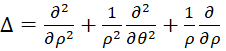 is the Laplace operator.
The displacement field in the plastic region is determined using the following relations. The total strain in the plastic zone consists of elastic and plastic components

The total strain components are related to the displacement function  by the Cauchy relations

The elastic components  are related to stresses in the plastic region by Hooke's law (5).
According to the associated plastic flow rule, for increments of plastic strains 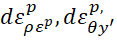 taking into account (2), we obtain


where  is a scalar multiplier.
At the elastic-plastic boundary, the displacement continuity condition holds

In relations (2)-(13), quantities with the dimension of stress are normalised by the yield stress , and quantities with the dimension of length are normalised by the radius of the elastic-plastic boundary  for isotropic torsion. The superscripts "p" and "e" indicate plastic and elastic regions, respectively.
According to the perturbation method [4], the unknown quantities are represented as series in powers of a small dimensionless parameter  :
:

 (14)
(14)
where  is the elastic-plastic boundary.
Similarly, the anisotropy parameters are expanded [5]:

Substituting (14) and (15) into (2)-(13) and equating terms of the same order in  , we obtain systems of equations for each approximation.
In the zeroth approximation, we obtain the isotropic torsion problem. Its solution [6] is

 (16)
(16)
In the first approximation:
Plastic stresses:

Elastic region displacement:

and corresponding stress components are obtained.
The radius of the elastic-plastic boundary is

From the flow rule:

After integration:

The displacement field in the plastic region satisfies.

Its solution, satisfying the continuity condition  is
is

3. Conclusion
In this paper, the stress and displacement fields of a circular cylinder under elastic–plastic torsion in the case of Hill-type anisotropy have been determined.
Using the perturbation method, the solution of the problem was constructed in the form of expansions with respect to a small parameter. In the zeroth approximation, the known solution for the isotropic elastic–plastic torsion of a circular cylinder was obtained. In the first approximation, analytical expressions were derived for the stress components in the plastic region, the displacement function in the elastic region, and the correction to the radius of the elastic–plastic boundary.
The plastic strain increments were determined using the associated flow rule and then integrated with respect to the twist parameter. Based on these results, the displacement field in the plastic region was obtained from the corresponding differential equation with the continuity condition at the elastic–plastic boundary.
Thus, the perturbation method makes it possible to obtain analytical expressions for the stress components, displacement fields, and the elastic–plastic boundary for a circular cylinder under torsion in the case of anisotropy according to Hill.
References:
- Kovalev, A.V., Shcheglova, Yu.D., Sviridov, I.E. (2014). Elastic–plastic torsion of a thick-walled tube in the case of translational anisotropy. In: Proceedings of the VIII All-Russian Conference on Mechanics of Deformable Solids. Cheboksary, Russia, pp. 193–199.
- Kovalev, A.V., Sviridov, I.E., Shcheglova, Yu.D. (2015). On determining displacements in the problem of elastic–plastic torsion of a circular cylinder in the case of translational anisotropy. In: Proceedings of the All-Russian Scientific School-Conference “Mechanics of Limit State and Related Problems”. Cheboksary, Russia, pp. 113–117.
- Mironov, B.G., Mitrofanova, T.V. (2011). On torsion of anisotropic cylindrical rods. Bulletin of the Chuvash State Pedagogical University. Series: Mechanics of Limit State, 1(9), 150–155.
- Ivlev, D.D., Ershov, L.V. (1978). Perturbation Methods in the Theory of Elastic–Plastic Bodies. Moscow: Nauka.
- Ivlev, D.A. (2011). On the limit state of layered anisotropic circular cylinders under torsion. Bulletin of the Chuvash State Pedagogical University. Series: Mechanics of Limit State, 1(9), 107–110.
- Kachanov, L.M. (1969). Fundamentals of the Theory of Plasticity. Moscow: Nauka.
- Tsvetkov, Yu.D. (1986). Torsion of an elastic–plastic cylindrical rod with a cross-section close to circular. In: Actual Problems of Continuum Mechanics. Cheboksary, Russia, pp. 117–125.
дипломов