Статья опубликована в рамках: XCIX Международной научно-практической конференции «Вопросы технических и физико-математических наук в свете современных исследований» (Россия, г. Новосибирск, 25 мая 2026 г.)
Наука: Математика
Секция: Математическая физика
Скачать книгу(-и): Сборник статей конференции
дипломов
PROBLEM OF A ROTATING DISK

ABSTRACT
This paper investigates the axisymmetric elastic–plastic behavior of a rapidly rotating disk made of a compressible ideal material. The elastic solution is formulated in cylindrical coordinates, and a piecewise-linear yield criterion is introduced to describe plasticity. Conditions for the initiation of the plastic zone are derived, and analytical solutions for stress distributions in different plastic regimes are obtained. The transition boundaries between regimes are also determined. The proposed approach provides an effective framework for analyzing rotating disks under various yield conditions.
Keywords: rotating disk; elastic–plastic behavior; piecewise-linear yield criterion; stress analysis; plastic zone.
1. Introduction
The analysis of rotating disks is a classical problem in solid mechanics with important engineering applications. The fundamental theories of elasticity and plasticity provide the basis for studying stress distributions in such structures [1,2]. The elastic–plastic behavior of rotating disks under classical yield criteria, such as Tresca and von Mises, has been extensively investigated [3–5], along with various analytical and modeling approaches [6,7].
In addition, generalized yield criteria, particularly piecewise-linear formulations, have attracted considerable attention due to their ability to approximate complex yield surfaces and describe multi-regime plastic behavior [8–13]. The associated flow rule and its generalizations have also been studied for isotropic materials [10,14–16], while fully plastic states have been analyzed in [15,17].
In this paper, an axisymmetric elastic–plastic problem for a rapidly rotating disk made of a compressible ideal material is considered. Based on a piecewise-linear yield condition, the initiation of plastic zones and the stress distribution in different regimes are obtained analytically.
2. Main Results
This paper considers an axisymmetric plane stress state of a rapidly rotating disk made of a compressible ideal elastic–plastic material. The problem of a rapidly rotating disk in the elastic state was investigated in [1]. In cylindrical coordinates, the stress components are given by: 
 . Here,
  is Poisson's ratio,
  ,
,  is the specific weight of the material,
  is the angular velocity of rotation,
  and
and  are constants determined from boundary conditions.
Consider a general piecewise-linear yield condition of the form:

In the principal stress plane (  ), this condition defines a yield polygon.
Let  be the inner radius, b be the outer radius of the disk.
The plastic region initiates at the boundary  when the pressures
  (inner boundary) and
  (outer boundary) satisfy:

The pressure must lie within the interval:

where

 .
.
Depending on the pressures prescribed at the boundaries:  several plastic regimes may occur in the region
  , corresponding to the sides of the yield polygon.
For the  -th plastic regime, the following conditions must hold:
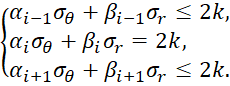
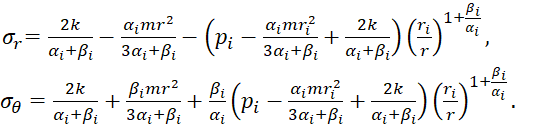
For each plastic regime in the region 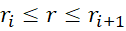 , the stress state is obtained from the Cauchy problem:
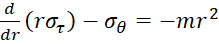 ,
,  (2)
(2)
The solution of problem (2) can be written as:
 (3)
(3)
If  , then
  .
.
Other boundaries between plastic regimes are obtained from:

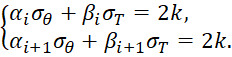
For  , the transition points correspond to the vertices of the yield polygon.
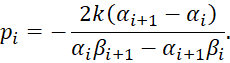
The pressure at  is determined from:
Thus,
3. Conclusion
In this study, the axisymmetric elastic–plastic problem of a rapidly rotating disk made of a compressible ideal material has been investigated. The elastic stress state was formulated in cylindrical coordinates, and a general piecewise-linear yield criterion was employed to describe the onset of plasticity.
Analytical expressions for the stress components in the plastic region were derived for different plastic regimes corresponding to the sides of the yield polygon. The conditions for the initiation of the plastic zone and the determination of transition boundaries between regimes were established in a consistent framework.
The obtained results demonstrate that the use of piecewise-linear yield criteria provides a flexible and effective approach for analyzing complex elastic–plastic behavior in rotating disks. The proposed method can be applied to various types of yield conditions and may be extended to more general problems involving non-uniform materials and loading conditions.
References:
- Belyaev, N. M. (1976). Strength of Materials. Moscow: Nauka.
- Sokolovsky, V. V. (1969). Theory of Plasticity. Moscow: Higher School.
- Gamer, U. (1983). Tresca’s yield condition and the rotating disk. Journal of Applied Mechanics (ASME), 50, 676.
- Eraslan, A. N., & Orcan, Y. (2002). Elastic–plastic deformation of a rotating solid disk of exponentially varying thickness. Mechanics of Materials, 34, 423–432.
- Rees, D. W. A. (1999). Elastic–plastic stresses in rotating discs by von Mises and Tresca criteria. Zeitschrift für Angewandte Mathematik und Mechanik (ZAMM), 79(4), 281–288.
- Yakubenko, A. P. (2013). Fundamental and applied problems of deformable solid mechanics, mathematical modeling and information technologies. In Proceedings of the International Scientific Conference (pp. 263–270). Cheboksary.
- Artemov, M. A., & Yakubenko, A. P. (2014). Mathematical modeling of the mechanical behavior of a rotating disk. Vestnik of Voronezh State University. Series: Physics and Mathematics, 1, 30–38.
- Hosford, W. F. (1972). A generalized isotropic yield criterion. Journal of Applied Mechanics, 39(2), 607–609.
- Karafillis, A. P., & Boyce, M. C. (1993). A general anisotropic yield criterion using bounds and a transformation weighting tensor. Journal of the Mechanics and Physics of Solids, 41(12), 1859–1886.
- Artemov, M. A., Baranovsky, E. S., & Yakubenko, A. P. (2015). Alternative forms of piecewise-linear yield conditions and their generalizations. Vestnik of Voronezh State University. Series: Physics and Mathematics, 1, 71–82.
- Artemov, M. A., & Baranovsky, E. S. (2014). Alternative representation of yield conditions. Advances in Current Natural Sciences, 12(3), 292.
- Artemov, M. A., Baranovsky, E. S., & Yakubenko, A. P. (2014). Limit yield conditions. In Proceedings of the International Scientific and Practical Conference on Education and Science (pp. 13–14).
- Artemov, M. A., Baranovsky, E. S., & Yakubenko, A. P. (2014). Piecewise-linear yield conditions. In Proceedings of the International Conference on Modern Problems of Mathematics, Mechanics and Informatics (pp. 103–110). Tula.
- Artemov, M. A., Baranovsky, E. S., & Yakubenko, A. P. (2014). Isotropy relations and associated flow rule. Vestnik of Voronezh State University. Series: Physics and Mathematics, 4, 81–90.
- Artemov, M. A., Potapov, N. S., & Yakubenko, A. P. (2009). Full plasticity condition and associated deformation law. Vestnik of Voronezh State Technical University, 5(9), 18–23.
- Artemov, M. A., Potapov, N. S., & Yakubenko, A. P. (2009). Consequences of the normal plastic flow law. Vestnik of Voronezh State Technical University, 5(9), 145–147.
- Artemov, M. A., Bestuzheva, N. P., & Potapov, N. S. (2010). On the fulfillment of the full plasticity condition under plane strain. Vestnik of Voronezh State Technical University, 6(7), 88–92.
дипломов