
Статья опубликована в рамках: Научного журнала «Студенческий» № 22(360)
Рубрика журнала: Информационные технологии
Скачать книгу(-и): скачать журнал
THE ROLE OF REAL-TIME TELEMETRY IN REDUCING MTTR IN DEVOPS ENVIRONMENTS

ABSTRACT
This article examines the role of real-time telemetry - unified metrics, logs, and distributed traces - in reducing Mean Time to Restore (MTTR) within cloud-native DevOps environments. Using a seeded Monte-Carlo simulation of 250 incidents across five fault classes, three operating regimes are compared: a reactive baseline, a fully observable environment, and a closed-loop automation framework (DOOF). The study decomposes MTTR into detection, isolation, and remediation stages to locate the precise mechanism of improvement.
Keywords: DevOps, Real-Time Telemetry, Observability, Monitoring, Logging, Distributed Tracing, MTTR, Incident Lifecycle, CI/CD, Microservices.
Traditional monitoring approaches are frequently insufficient in distributed systems. Threshold alarms on isolated host metrics produce noise without context, and reactive discovery - waiting for a downstream timeout or a user complaint - leaves failures latent for long periods. Observability has emerged in response as a distinct discipline within DevOps and Site Reliability Engineering. Rather than answering only pre-defined questions, observability combines metrics, logs, and traces so that engineers can interrogate the internal state of a system from its external outputs, and can ask questions that were not anticipated when the system was built.
The headline finding is a large and consistent effect of telemetry on restoration time. Introducing observability reduces composite MTTR from 37.30 minutes in the reactive regime to 15.55 minutes - a 58.3% reduction. Adding the DOOF closed loop reduces it further to 5.79 minutes, an 84.5% reduction relative to the reactive baseline and a 62.8% reduction relative to human-in-the-loop observability. The improvement is monotonic across every fault class, as shown in Figure 1; the largest absolute gains occur precisely for the quiet, fail-slow faults - disk saturation and network latency - that a blind regime is least equipped to notice.
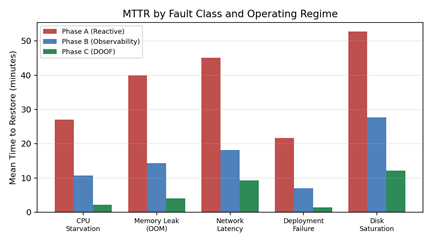
Fig. 1. Mean Time to Restore by fault class and operating regime. The reduction from reactive (A) to observable (B) to automated (C) is monotonic across all faults.
Table 1 aggregates the composite and per-fault results. The per-fault figures reveal that the relative benefit of each step depends on the nature of the fault. Loud, automatable faults such as deployment failure and CPU starvation yield the largest relative gains from automation, reaching 93.7% and 91.9% reductions respectively under DOOF, because their conditions are cleanly detectable and their remediation - rollback, restart, or scale - can be expressed as a deterministic webhook action. Quiet faults retain a larger residual, partly because a fraction of them are modeled as requiring human escalation even under automation.
Table 1.
Composite and per-fault MTTR (minutes) across the three regimes, with percentage reductions relative to the reactive baseline.
|
Fault Scenario |
A (min) |
B (min) |
C (min) |
A→B |
A→C |
|
CPU Starvation |
26.99 |
10.70 |
2.19 |
60.4% |
91.9% |
|
Memory Leak (OOM) |
39.93 |
14.29 |
4.00 |
64.2% |
90.0% |
|
Network Latency |
45.09 |
18.12 |
9.25 |
59.8% |
79.5% |
|
Deployment Failure |
21.70 |
6.99 |
1.37 |
67.8% |
93.7% |
|
Disk Saturation |
52.79 |
27.66 |
12.15 |
47.6% |
77.0% |
|
Composite |
37.30 |
15.55 |
5.79 |
58.3% |
84.5% |
A reduction in MTTR is only persuasive once its mechanism is understood. Decomposing the lifecycle into Mean Time to Detect (MTTD), Mean Time to Isolate (MTTI), and Mean Time to Remediate (MTTRem) locates exactly where telemetry acts. As Table 2 and Figure 2 show, observability operates almost entirely on the informational stages. Mean Time to Isolate collapses from 16.47 minutes in Phase A to 3.20 minutes in Phase B - the single largest contributor to the overall gain - because unified dashboards and distributed traces point engineers directly at the failing service and its stack trace, eliminating the manual search across ephemeral pods. Mean Time to Detect falls from 9.04 to 1.99 minutes as reactive discovery is replaced by sub-scrape-interval alerting.
Crucially, remediation time changes very little between Phase A and Phase B. This is exactly as predicted: the human fix for a given fault is the same regardless of how it was found; only the time required to reach a confirmed root cause shrinks. The central analytical conclusion follows directly - real-time monitoring and logging optimize DevOps not by making fixes faster but by making the path to the fix shorter. The remaining opportunity is the human handoff itself, and that is precisely what the closed-loop controller of Phase C is designed to remove, driving isolation to 1.04 minutes and compressing remediation into the sub-minute, webhook-driven regime for automatable faults.
Table 2.
Decomposition of composite MTTR into lifecycle stages (minutes).
|
Regime |
MTTD |
MTTI |
MTTRem |
Total |
|
Phase A (Reactive) |
9.04 |
16.47 |
11.79 |
37.30 |
|
Phase B (Observability) |
1.99 |
3.20 |
10.36 |
15.55 |
|
Phase C (DOOF) |
0.79 |
1.04 |
3.97 |
5.80 |
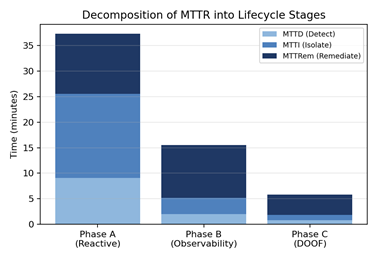
Fig. 2. Stacked decomposition of MTTR. The dominant effect of observability is the collapse of the detect and isolate stages; remediation cost is reduced only once automation removes the human handoff in Phase C.
The mechanism by which Phase C converts telemetry into action is a single decision variable, the Variation Index, evaluated during a canary deployment. It fuses the three observability pillars by combining the relative deviations of latency, error rate, and saturation against a healthy baseline, weighted by a service's risk profile. In the experiments the weights are set to (β, γ, δ) = (0.30, 0.50, 0.20), placing the heaviest emphasis on user-visible errors as the strongest signal of a toxic release.
In conclusion, real-time telemetry should be regarded as a foundational component of modern DevOps environments rather than an optional enhancement. The evidence indicates that its primary contribution to reducing MTTR lies in collapsing the detection and isolation stages of the incident lifecycle - shortening the path to a fix rather than the fix itself - while closed-loop automation built on the same telemetry removes the residual human handoff and simultaneously improves deployment safety.
References:
- Forsgren N., Humble J., Kim G. Accelerate: The Science of Lean Software and DevOps. IT Revolution Press, 2018.
- Kim G., Humble J., Debois P., Willis J. The DevOps Handbook. IT Revolution Press, 2021.
- Beyer B., Jones C., Petoff J., Murphy N. R. Site Reliability Engineering. O'Reilly Media, 2016.