
Статья опубликована в рамках: Научного журнала «Студенческий» № 21(359)
Рубрика журнала: Информационные технологии
Скачать книгу(-и): скачать журнал
SENTIMENT ANALYSIS OF STEAM GAME REVIEWS USING LEXICON-BASED NLP METHODS

ABSTRACT
This paper analyzes Steam game reviews using lexicon-based NLP methods. Two sentiment analysis tools, TextBlob and VADER, are used to evaluate review polarity and emotional intensity. The dataset was collected from Steam through the Steam Storefront API and includes review texts, playtime, review length, and helpful votes. The results show differences between the two methods and indicate that sentiment scores have only weak relationships with player engagement features.
Keywords: sentiment analysis, Steam reviews, natural language processing, TextBlob, VADER.
1 Problem Statement
Online game platforms generate large volumes of user-generated content in the form of reviews and comments. These reviews often contain valuable information about player satisfaction, game quality, and user experience. Steam allows users with recorded playtime to write reviews, which may appear on the product’s store page and in the Steam Community [1]. Analyzing this textual data can help researchers understand player opinions and behavioral patterns.
Sentiment analysis is a widely used technique in natural language processing that aims to identify emotional polarity in text [2]. Lexicon-based methods are particularly useful because they do not require large labeled datasets and can be applied directly to raw text data [2]. However, different sentiment analysis tools may produce different results due to variations in their lexical resources and scoring mechanisms.
The objective of this work is to analyze sentiment in Steam game reviews using two lexicon-based methods and to investigate how sentiment scores relate to user behavior indicators such as playtime and review length.
2. Dataset and Methods
The dataset used in this study consists of reviews collected from Steam using the Steam Storefront API. The reviews were retrieved through the Steam Storefront appreviews interface, with the language parameter set to English [3]. The dataset includes textual content as well as behavioral features such as playtime, review length, and helpful votes. The sentiment analysis tools TextBlob and VADER were applied to analyze review sentiment. TextBlob provides polarity and subjectivity scores [4], whereas VADER provides negative, neutral, positive, and compound sentiment scores [5].
3. Results
The sentiment analysis results show that both TextBlob and VADER generally classify most reviews as positive. However, there are notable differences between the two methods. TextBlob tends to classify many reviews as neutral or weakly positive, while VADER assigns stronger positive sentiment to reviews. This difference is particularly evident in long reviews and reviews with mixed emotions. Furthermore, VADER appears to capture emotional intensity better due to its sensitivity to informal and emotionally expressive language.
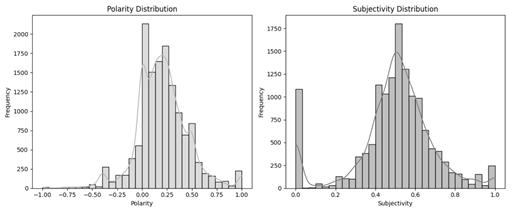
Figure 1. TextBlob Sentiment Distribution
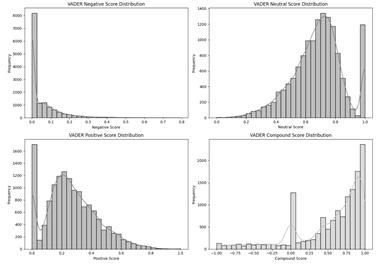
Figure 2. VADER Sentiment Distribution
4. Analysis
TextBlob is more conservative, often classifying reviews as neutral or mildly positive, while VADER is more sensitive to emotional expression and gives more positive results. This shows that sentiment tools may interpret informal Steam reviews differently. The study also found that playtime and review length do not strongly correlate with sentiment scores.
References:
- Steamworks Documentation. User Reviews [Electronic resource]. – Available at: https://partner.steamgames.com/doc/store/reviews (accessed: 18.03.2026).
- Liu B. Sentiment Analysis and Opinion Mining. – San Rafael: Morgan & Claypool Publishers, 2012. – 167 p.
- Steamworks Documentation. User Reviews – Get List [Electronic resource]. – Available at: https://partner.steamgames.com/doc/store/getreviews (accessed: 18.03.2026).
- TextBlob Documentation. Quickstart [Electronic resource]. – Available at: https://textblob.readthedocs.io/en/dev/quickstart.html (accessed: 18.03.2026).
- Hutto C.J., Gilbert E.E. VADER: A Parsimonious Rule-Based Model for Sentiment Analysis of Social Media Text // Proceedings of the International AAAI Conference on Web and Social Media. – 2014. – Vol. 8. – P. 216–225.