
Статья опубликована в рамках: Научного журнала «Студенческий» № 20(358)
Рубрика журнала: Информационные технологии
Скачать книгу(-и): скачать журнал
CASCADED NEURAL ARCHITECTURES FOR INTELLIGENT ROUTING AND DECISION-SUPPORT IN TELEMEDICINE

КАСКАДНЫЕ НЕЙРОННЫЕ АРХИТЕКТУРЫ ДЛЯ ИНТЕЛЛЕКТУАЛЬНОЙ МАРШРУТИЗАЦИИ И ПОДДЕРЖКИ ПРИНЯТИЯ РЕШЕНИЙ В ТЕЛЕМЕДИЦИНЕ
Чжан Мань
студент, Институт прикладной математики и информатики, Национальный исследовательский Томский Государственный,
РФ, г. Томск
ABSTRACT
This paper proposes the Unified Intelligent Routing and Suggestion (UIRS) framework, a decision-support system using a two-stage cascaded neural architecture. It integrates a MacBERT module for precise department routing and a fine-tuned GPT-2 generative module to construct safe medical guidance, demonstrating high robustness across 177 departments.
АННОТАЦИЯ
В этой статье предлагается платформа Unified Intelligent Routing and Suggestion (UIRS) - система поддержки принятия решений, использующая двухэтапную каскадную нейронную архитектуру. Он объединяет модуль MacBERT для точной маршрутизации отделений и отлаженный генерирующий модуль GPT-2 для создания безопасного медицинского руководства, демонстрируя высокую надежность в 177 отделениях.
Keywords: decision support systems; intelligent routing; telemedicine; system architecture; cascaded neural networks.
Ключевые слова: системы поддержки принятия решений; интеллектуальная маршрутизация; телемедицина; системная архитектура; каскадные нейронные сети.
Introduction. The integration of advanced AI into healthcare has transformed telemedicine [1, 2]. However, automated patient triage has emerged as a critical system bottleneck. Real-world medical data exhibits a severe long-tail distribution, making it exceedingly difficult for a single-turn routing algorithm to distinguish between overlapping interdisciplinary departments [3]. Furthermore, isolated classification models lack a human-centric feedback loop. This study proposes the Unified Intelligent Routing and Suggestion (UIRS) framework, which is a cascaded architecture aimed at addressing these limitations in modern smart healthcare systems.
Methods. We propose the UIRS framework based on a two-stage cascaded architecture. In Stage 1 (Intelligent Routing), we formulate the triage task as a 177-class routing problem. The input sequence X is processed by a MacBERT encoder [4]. The probability distribution over the target departments D is computed via a linear projection:

To counter the long-tail distribution, we utilize a class-weighted Focal Loss [5].
In Stage 2 (Feedback Generation), we cascade a fine-tuned GPT-2 model [6]. A dynamic prompt C is constructed by concatenating the predicted department label d and the query X. The module models the conditional probability of the response R autoregressively:
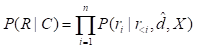
This stage is constrained by strict rules to prevent LLM hallucinations, explicitly prohibiting medication prescriptions.
Results and Discussion. Our study utilizes a curated dataset spanning 177 fine-grained medical departments, comprising over 2.8 million dialogue sessions. We employed stratified sampling to preserve the long-tail distribution. As illustrated in Fig. 1, the system demonstrates rapid convergence and exceptional discriminative capability. Over 85% of the monitored departments achieved an AUC exceeding 0.98. The correct department is consistently ranked at the top of the probability distribution.
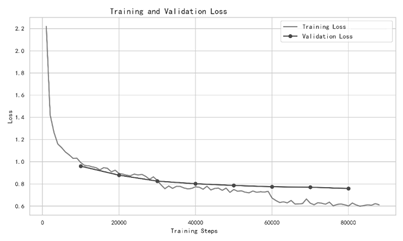
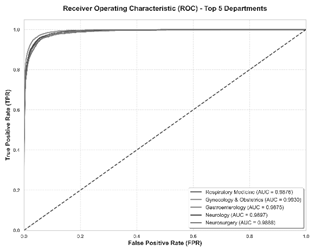
Fig. 1. System training convergence (left) and ROC curves for Top 5 departments (right)
To validate the architectural components, we conducted an ablation study on the routing module (Table 1). Replacing MacBERT with standard BERT resulted in a 4.3% drop in the Macro F1 score, proving that character-level tokenization struggles with Chinese medical boundaries. Omitting the Focal Loss caused the Macro F1 to plummet to 0.795.
Table 1.
Ablation study result
|
|
Macro F1 |
Micro F1 |
Top-3 Acc. |
|
Full UIRS (MacBERT) |
0.874 |
0.912 |
0.985 |
|
WWM (standard BERT) |
0.831 |
0.885 |
0.952 |
|
Focal Loss (standard CE) |
0.795 |
0.890 |
0.941 |
|
Transformer (TextCNN) |
0.652 |
0.763 |
0.820 |
Conclusion. The proposed UIRS framework effectively integrates automated routing with generative feedback. Our evaluations demonstrate that the architecture is robust against long-tail distributions, while the GPT-2 component successfully bridges the semantic ambiguity gap. Future research could focus on integrating broader multimodal data to further enhance diagnostic accuracy and triage performance.
References:
- Topol E.J. High-performance medicine: the convergence of human and artificial intelligence // Nature medicine. – 2019. – Vol. 25, No. 1. – P. 44–56.
- Deep learning for healthcare: review, opportunities and challenges / R. Miotto, F. Wang, S. Wang et al. // Briefings in bioinformatics. – 2018. – Vol. 19, No. 6. – P. 1236–1246.
- Text classification algorithms: A survey / K. Kowsari, K. Jafari Meimandi, M. Heidari et al. // Information. – 2019. – Vol. 10, No. 4. – P. 150.
- Revisiting Pre-Trained Models for Chinese NLP / Y. Cui, W. Che, T. Liu et al. // Findings of EMNLP. – 2020. – P. 657–668.
- Focal loss for dense object detection / T.Y. Lin, P. Goyal, R. Girshick et al. // Proceedings of ICCV. – 2017. – P. 2980–2988.
- Language models are unsupervised multitask learners / A. Radford, J. Wu, R. Child et al. // OpenAI blog. – 2019. – Vol. 1, No. 8. – P. 9.