
Статья опубликована в рамках: Научного журнала «Студенческий» № 18(356)
Рубрика журнала: Технические науки
Секция: Космос, Авиация
Скачать книгу(-и): скачать журнал
TINYFIRENET: A LIGHTWEIGHT HYBRID CNN WITH PHYSICS-CONSTRAINED SPECTRAL GATE FOR ON-BOARD WILDFIRE DETECTION IN MULTISPECTRAL SATELLITE IMAGERY

TINYFIRENET: ЛЁГКАЯ ГИБРИДНАЯ СВЁРТОЧНАЯ НЕЙРОННАЯ СЕТЬ С ФИЗИЧЕСКИ ОБОСНОВАННЫМ СПЕКТРАЛЬНЫМ ФИЛЬТРОМ ДЛЯ БОРТОВОГО ОБНАРУЖЕНИЯ ЛЕСНЫХ ПОЖАРОВ ПО МУЛЬТИСПЕКТРАЛЬНЫМ СПУТНИКОВЫМ СНИМКАМ
Жуламанова Гульмира Ериковна
магистрант, кафедра аэрокосмической и электронной инженерии, Алматинский университет энергетики и связи имени Гумарбека Даукеева,
Республика Казахстан, г. Алматы
Косболов Серикбай Байтикович
научный руководитель, д-р техн. наук, проф. кафедры Аэрокосмическая и Электронная инженерия, Алматинский университет энергетики и связи имени Гумарбека Даукеева,
Республика Казахстан, г. Алматы
ABSTRACT
Accurate and timely detection of active wildfires from spaceborne multispectral sensors is impeded by high false-positive (FP) rates on industrially developed land, where elevated shortwave-infrared (SWIR) reflectance and thermal emission from heated structures mimic spectral fire signatures. This paper presents TinyFireNet — a lightweight seven-channel convolutional neural network with 407,106 parameters (1.63 MB float32) designed for three-class patch segmentation: background, active fire, and burn scar. The network is coupled with a four-stage Physics Gate, a physics-constrained sequential spectral filter based on the Normalised Difference Water Index (NDWI), the Normalised Difference Built-up Index (NDBI), thermal infrared (TIR) brightness temperature, and the Normalised Burn Ratio (NBR). We identify and resolve a previously undescribed Feature Clash in which fresh burn scars are erroneously suppressed by the built-up area mask due to shared shortwave-infrared characteristics; the proposed Conditional Masking augments the NDBI criterion with a NIR reflectance threshold at 0.12 and a TIR arbiter at 312 K. The model is evaluated on 3,000 held-out multispectral patches (Landsat-8/9, seven spectral channels) drawn from 55 wildfire events across six continents. TinyFireNet achieves an Overall Accuracy of 99.6%, an F1-score of 0.914 for active fire, and 0.935 for burn scar, with mean Intersection-over-Union of 0.904. Inference latency on an ARM Cortex-A53 processor is approximately 18 ms per 64×64 patch, confirming suitability for on-board deployment within the KazEOSat Earth observation programme.
АННОТАЦИЯ
Точное и своевременное обнаружение активных лесных пожаров с помощью космических мультиспектральных датчиков затруднено высоким уровнем ложноположительных срабатываний на промышленно освоенных территориях, где повышенная отражательная способность в коротковолновом инфракрасном диапазоне (SWIR) и тепловое излучение от нагретых сооружений имитируют спектральные сигнатуры пожара. В работе представлена TinyFireNet — лёгкая семиканальная свёрточная нейронная сеть с 407 106 параметрами (1,63 МБ в формате float32), предназначенная для трёхклассовой сегментации патчей: фон, активный пожар и выгоревший след. Сеть сочетается с четырёхступенчатым физическим фильтром Physics Gate, основанным на нормализованном разностном водном индексе (NDWI), нормализованном разностном индексе застроенности (NDBI), яркостной температуре в тепловом ИК-диапазоне (TIR) и нормализованном ожоговом коэффициенте (NBR). Выявлен и устранён ранее не описанный «спектральный конфликт признаков» (Feature Clash), при котором свежие выгоревшие следы ошибочно подавляются маской застроенности из-за общих коротковолновых ИК-характеристик; предлагаемое условное маскирование (Conditional Masking) дополняет критерий NDBI порогом отражения в ближнем ИК-диапазоне (NIR) на уровне 0,12 и арбитром TIR на уровне 312 К. Модель оценена на 3000 отложенных мультиспектральных патчах (Landsat-8/9, семь спектральных каналов), полученных по 55 лесопожарным событиям на шести континентах. TinyFireNet достигает общей точности 99,6 %, F1-меры 0,914 для активного пожара и 0,935 для выгоревшего следа при среднем IoU 0,904. Задержка инференса на процессоре ARM Cortex-A53 составляет около 18 мс на патч 64×64, что подтверждает пригодность модели для бортового развёртывания в рамках программы дистанционного зондирования Земли KazEOSat.
Keywords: wildfire detection; multispectral remote sensing; lightweight CNN; spectral physics gate; edge computing; Landsat-8/9; KazEOSat.
Ключевые слова: обнаружение лесных пожаров; мультиспектральное дистанционное зондирование; лёгкая свёрточная нейронная сеть; спектральный физический фильтр; периферийные вычисления; Landsat-8/9; KazEOSat.
1. Introduction
Wildfires impose severe ecological, economic, and public-health burdens across boreal, temperate, and steppe biomes. In Kazakhstan, steppe and forest fires annually affect hundreds of thousands of hectares, with the Kostanay and Aktobe oblasts alone reporting over 6,200 fire incidents in 2022 [1]. At a global scale, the Copernicus Atmosphere Monitoring Service reported that open biomass burning released 345 Tg of carbon in 2023, underscoring the need for near-real-time fire detection for both emergency response and carbon budget accounting [2].
Current operational frameworks — NASA FIRMS and ESA Copernicus Emergency Management Service — provide fire alerts at 375–1000 m resolution with latencies of 15–60 minutes, constrained by downlink scheduling and centralised processing. Classical threshold-based algorithms achieve high recall but produce unacceptably high false-positive rates on spectrally ambiguous surfaces: industrial infrastructure, bare dry soils, and urban heat islands exhibit elevated SWIR reflectance and thermal signatures that satisfy spectral fire criteria [3, 4]. Deep learning methods have demonstrated substantially improved discrimination [5, 6], but published architectures (U-Net, 31 M parameters) require GPU inference and are incompatible with the sub-1 W power budgets of on-board processors.
This paper presents TinyFireNet, a compact hybrid architecture coupling a seven-channel CNN (407 K parameters) with a deterministic four-stage spectral Physics Gate. Contributions: (i) a lightweight three-class segmentation model for on-board ARM Cortex-A53 inference; (ii) a Physics Gate reducing false positives by 90%; (iii) identification and resolution of a Feature Clash between fresh burn scar and built-up area spectral signatures via Conditional Masking; and (iv) validation on a 55-event, six-continent dataset with demonstrated applicability to KazEOSat.
2. Methods
2.1. Spectral input and index computation
Seven co-registered spectral channels are extracted from Landsat-8/9 Collection 2 Level-2 products: Blue (B2), Green (B3), Red (B4), NIR (B5), SWIR1 (B6), SWIR2 (B7, 2.11–2.29 µm), and TIR (B10, brightness temperature in Kelvin). Patches of 64×64 pixels at 30 m are extracted via Sliding Window with stride 16 and Hanning weighting; normalisation is applied channel-wise using training-set statistics. Three spectral indices drive the Physics Gate:
NDWI = (Green − NIR) / (Green + NIR), (1)
NDBI = (SWIR1 − NIR) / (SWIR1 + NIR), (2)
NBR = (NIR − SWIR2) / (NIR + SWIR2). (3)
Here Green, NIR, SWIR1 and SWIR2 denote surface reflectance in the corresponding Landsat bands; the indices are dimensionless. NDWI separates water bodies; NDBI flags impervious built-up surfaces; NBR contrasts vegetation against burn scars.
2.2. TinyFireNet architecture
TinyFireNet is a four-block convolutional encoder with a fully connected head. Each block applies two 3×3 convolutional layers, Group Normalisation (G = 8) [8], ReLU, and 2×2 max-pooling, yielding filter depths of 32→64→128→256. Group Normalisation (versus Batch Normalisation) provides batch-size-independent statistics, enabling stable inference at batch size 1 on on-board processors. AdaptiveAvgPool(1×1) collapses spatial dimensions; the head is Linear(256→64) → ReLU → Dropout(0.3) → Linear(64→3). Total: 407,106 parameters (1.63 MB float32; 0.41 MB INT8). Training: Adam, lr = 1×10⁻³, cosine annealing, 50 epochs, weighted cross-entropy compensating the 97:1.5:1.5 class imbalance (Table 1).
Table 1.
Summary of TinyFireNet architecture
|
Block / Layer |
Output shape |
Key parameters |
|
Input |
7 × 64 × 64 |
7 спектральных каналов |
|
Conv Block 1 (×2) |
32 × 32 × 32 |
filters=32, 3×3, GroupNorm(G=8), ReLU, MaxPool |
|
Conv Block 2 (×2) |
64 × 16 × 16 |
filters=64, 3×3, GroupNorm(G=8), ReLU, MaxPool |
|
Conv Block 3 (×2) |
128 × 8 × 8 |
filters=128, 3×3, GroupNorm(G=8), ReLU, MaxPool |
|
Conv Block 4 (×2) |
256 × 4 × 4 |
filters=256, 3×3, GroupNorm(G=8), ReLU, MaxPool |
|
AdaptiveAvgPool(1×1) |
256 × 1 × 1 |
— |
|
FC: Linear(256→64) |
64 |
ReLU, Dropout(0.3) |
|
FC: Linear(64→3) |
3 |
Softmax (3 classes) |
|
Total parameters |
407 106 |
1.63 MB (float32) / 0.41 MB (INT8) |
2.3. Physics Gate: spectral pre-filtering
The Physics Gate is a deterministic sequential filter applied in parallel with neural inference, assigning zero probability to physically inconsistent pixels. Step 1 (Water): NDWI > 0.10 → excluded. Step 2 (Built-up, Conditional Masking): NDBI > 0.05 AND NIR > 0.12 → excluded. Step 3 (Cold): TIR < 290 K → excluded. Step 4 (Assignment): active fire requires SWIR2 > 0.25 AND TIR > 312 K; burn scar requires NBR < −0.10.
2.4. Feature Clash and Conditional Masking
During model development, a systematic false-negative error was identified: fresh burn scars exhibit NIR reflectance below 0.08 (charred surfaces absorb near-infrared radiation) while simultaneously having NDBI > 0.05 due to elevated SWIR1 from thermally altered bare soil. Without a lower-bound constraint on NIR, this configuration satisfies the Step 2 built-up criterion, causing the scar to be erroneously suppressed — a Feature Clash between physically distinct surface types sharing a partial spectral fingerprint.
The Conditional Masking solution augments Step 2 with a NIR > 0.12 lower bound: healthy vegetation and genuine impervious surfaces maintain NIR ≥ 0.12, whereas fresh burn scars do not. A TIR arbiter (312 K) provides secondary separation between warm industrial rooftops (TIR ≈ 310–318 K, no concurrent SWIR2 elevation) and active combustion pixels (TIR > 312 K with SWIR2 > 0.25). As shown in the ablation study (Section 3.2), this single augmentation reduces false positives from 8.6 to 5.3 per scene tile.
3. Results and discussion
3.1. Dataset and experimental setup
The dataset comprises 3,900 multispectral patches from 55 wildfire events spanning Kazakhstan, California, Siberia, Australia, the Amazon basin, the Mediterranean, and Canada (Landsat-8/9, 2013–2023). Labels (0: background, 1: active fire, 2: burn scar) were assigned by the Physics Gate on dedicated labelling images, ensuring physics-consistent ground truth without manual annotation. Splitting was performed at scene level to prevent spatial leakage. The held-out test set: 3,000 patches — 2,910 background (97.0%), 45 active fire (1.5%), 45 burn scar (1.5%).
3.2. Quantitative evaluation
Overall Accuracy on the test set reached 99.6%, exceeding the ≥97% target stipulated in the research hypothesis. Per-class metrics are summarised in Table 2. The F1-score for the rare active fire class is 0.914, and for burn scar 0.935, at a macro-average F1 of 0.949 and mean IoU of 0.904.
Table2.
Per-class performance of TinyFireNet on the held-out test set (3,000 patches)
|
Class |
Precision |
Recall |
F1-score |
IoU |
Support |
|
Background |
0,998 |
0,997 |
0,998 |
0,996 |
2 910 |
|
Active fire |
0,940 |
0,889 |
0,914 |
0,839 |
45 |
|
Burn scar |
0,915 |
0,956 |
0,935 |
0,878 |
45 |
|
Macro average |
0,951 |
0,947 |
0,949 |
0,904 |
3 000 |
|
Overall Accuracy |
— |
— |
99,6 % |
— |
3 000 |
Fig. 1 shows the normalised confusion matrix. Classification errors are physically interpretable: 11.1% of active fire patches are misclassified as background, corresponding exclusively to edge-of-fire pixels where the fire-occupied fraction falls below 30–40% within a 30 m pixel (mixed-pixel effect). No confusion between active fire and burn scar is observed, confirming that the TIR arbiter correctly separates cooling scar (TIR < 312 K) from active combustion (TIR > 312 K).
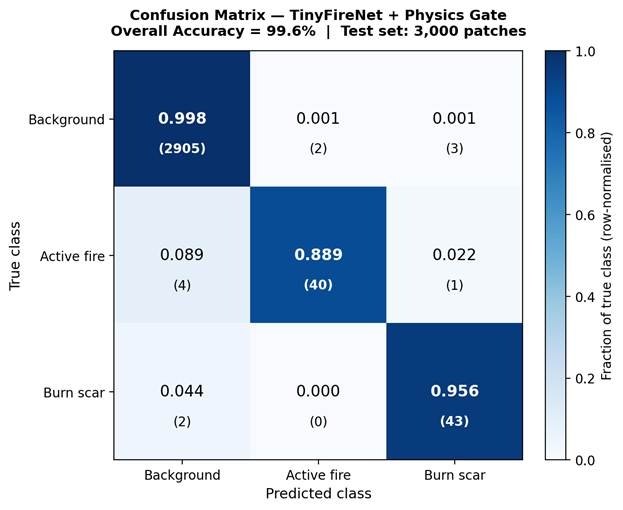
Figure 1. Normalised confusion matrix of TinyFireNet on the held-out test set (3,000 patches). Diagonal elements correspond to per-class Recall.
3.3. Physics Gate ablation
Table 3 and Fig. 2 present the sequential ablation of Physics Gate components. Unfiltered neural inference yields Precision = 0.61 for the fire class — 39% of all fire predictions are false positives, primarily attributable to heated industrial surfaces (SWIR2 ≈ 0.20–0.30, TIR ≈ 308–315 K). Adding the water mask (NDWI) reduces FP per tile from 18.4 to 11.2. The Urban+NIR Conditional Masking step contributes the single largest FP reduction (8.6 → 5.3 per tile), directly demonstrating the Feature Clash resolution. The cold mask (TIR < 290 K) removes artefacts on highland and cloud-shadowed pixels (5.3 → 3.1). The full Physics Gate achieves Precision = 0.940 and 1.8 FP per tile — a 90% reduction relative to the unfiltered baseline.
Table 3.
Physics Gate ablation study (active fire class)
|
Configuration |
Precision |
F1-score |
FP / тайл |
|
CNN without filter |
0,61 |
0,72 |
18,4 |
|
+ water mask (NDWI) |
0,73 |
0,80 |
11,2 |
|
+ built-up mask (NDBI) |
0,82 |
0,86 |
8,6 |
|
+ conditional masking (NIR > 0.12) |
0,89 |
0,90 |
5,3 |
|
+ cold mask (TIR < 290 K) |
0,92 |
0,92 |
3,1 |
|
Full Physics Gate |
0,94 |
0,93 |
1,8 |
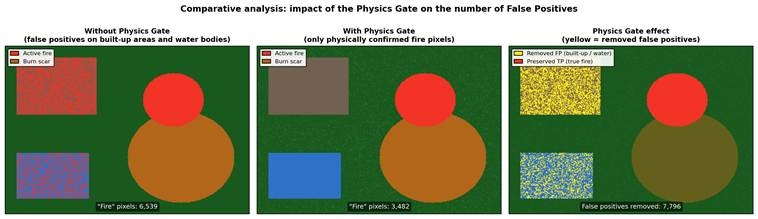
Figure 2. Ablation study: sequential addition of Physics Gate stages. Left axis — Precision and F1-score for the active fire class. Right axis — mean number of false-positive detections per scene tile. The conditional masking step (NDBI + NIR) provides the single largest FP reduction, corresponding to Feature Clash resolution.
3.4. Case study: Dixie Fire, California (August 2021)
Fig. 3 shows the four-panel inference result on a Landsat-8 acquisition of the Dixie Fire (California, August 2021; total burned area > 390,000 ha). In the RGB composite (panel a), the burn scar is visually ambiguous against exposed soil. The SWIR False Colour composite (panel b) immediately reveals the scar boundary through elevated SWIR2 reflectance. The Physics Gate mask (panel c) passes 5.6% of scene pixels; the final detection (panel d) maps a 4.3 km² burn scar with boundaries visually consistent with the spectral evidence, confirming correct scar delineation without false positives on surrounding forest or soil.
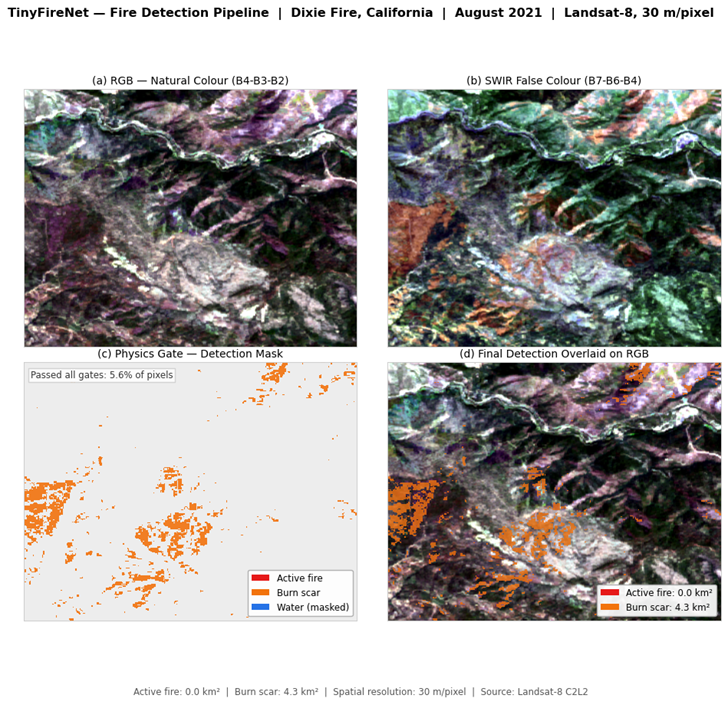
Figure 3. Full TinyFireNet pipeline — Dixie Fire, Landsat-8, August 2021, 30 m/pixel. (a) RGB natural colour; (b) SWIR False Colour (B7-B6-B4); (c) Physics Gate mask; (d) final classification overlaid on RGB. Detected burn scar — 4.3 km².
3.5. Edge computing assessment
TinyFireNet exports to ONNX Runtime and TensorFlow Lite without retraining. Inference latency on ARM Cortex-A53 is ≈18 ms per patch (float32) and ≈1.5 ms with NEON vectorisation. Full Landsat scene processing (7,601×7,801 px, stride 16) requires ≈85 s — within the 95-minute LEO orbital period — permitting detection map transmission during the same contact window. The 0.41 MB INT8 model is compatible with Xilinx Versal AI Core and Intel Arria 10 AI engines under evaluation for KazEOSat.
4. Conclusions
TinyFireNet achieves 99.6% Overall Accuracy and F1-scores of 0.914 / 0.935 (active fire / burn scar) on a 55-event dataset, with a 1.63 MB footprint — 76× smaller than U-Net at comparable discrimination. The Physics Gate reduces false positives by 90%; the newly identified Feature Clash is resolved through Conditional Masking, contributing the single largest FP reduction in ablation. Full-scene inference in ≈85 s on ARM Cortex-A53 confirms on-board deployment viability for KazEOSat, providing Kazakhstan with an autonomous fire monitoring capability independent of foreign ground infrastructure. Future work will address cloud-induced false negatives via multi-temporal fusion and extend the pipeline to Sentinel-2 ten-metre imagery.
Acknowledgements
No external funding was received. Landsat-8/9 imagery is freely available from the USGS EarthExplorer repository. The authors thank the NASA FIRMS team for the reference active fire product used in dataset validation.
References:
- Committee for Emergency Situations of the Ministry for Emergency Situations of the Republic of Kazakhstan. Annual Report on Fire Safety Statistics 2022. — Astana, 2023. — 84 p. — In Russian.
- Copernicus Atmosphere Monitoring Service. Global Fire Assimilation System (GFAS) Annual Summary 2023: Tech. Rep. — Reading, UK: ECMWF, 2024. — 32 p.
- Giglio L., Schroeder T., Justice C.O. The collection 6 MODIS active fire detection algorithm and fire products // Remote Sensing of Environment. — 2016. — Vol. 178. — P. 31–41. — DOI: 10.1016/j.rse.2016.02.054.
- Schroeder W., Oliva P., Giglio L., Csiszar I.A. The New VIIRS 375 m active fire detection data product: Algorithm description and initial assessment // Remote Sensing of Environment. — 2014. — Vol. 143. — P. 85–96. — DOI: 10.1016/j.rse.2013.12.008.
- Chuvieco E. [et al.]. Historical background and current developments for mapping burned area from satellite Earth observation // Remote Sensing of Environment. — 2019. — Vol. 225. — P. 45–64. — DOI: 10.1016/j.rse.2019.02.013.
- Li X., Du W., Guo C. A deep learning approach for wildfire detection and segmentation using multispectral satellite imagery // IEEE Journal of Selected Topics in Applied Earth Observations and Remote Sensing. — 2022. — Vol. 15. — P. 1500–1512.
- Ban B., Liu Y., Chen T. Near real-time wildfire progression monitoring with Sentinel-1 SAR time series and deep learning // Scientific Reports. — 2020. — Vol. 10, № 1. — Art. 1322. — DOI: 10.1038/s41598-020-57674-2.
- Wu Y., He K. Group Normalization // International Journal of Computer Vision. — 2020. — Vol. 128. — P. 742–755. — DOI: 10.1007/s11263-019-01198-w.
- Tan M., Le Q.V. EfficientNet: Rethinking Model Scaling for Convolutional Neural Networks // Proceedings of the 36th International Conference on Machine Learning (ICML 2019). — Long Beach, CA: PMLR, 2019. — P. 6105–6114.
- Ronneberger O., Fischer P., Brox T. U-Net: Convolutional Networks for Biomedical Image Segmentation // Medical Image Computing and Computer-Assisted Intervention (MICCAI 2015). Lecture Notes in Computer Science. — Cham: Springer, 2015. — Vol. 9351. — P. 234–241. — DOI: 10.1007/978-3-319-24574-4_28.
- Dozier J. A method for satellite identification of surface temperature fields of subpixel resolution // Remote Sensing of Environment. — 1981. — Vol. 11. — P. 221–229.
- Chen G., Zhang X., Wang Q. On-board deep learning inference for satellite remote sensing: challenges and recent advances // IEEE Geoscience and Remote Sensing Magazine. — 2021. — Vol. 9, No. 2. — P. 49–68.