Статья опубликована в рамках: XCIII Международной научно-практической конференции «Вопросы технических и физико-математических наук в свете современных исследований» (Россия, г. Новосибирск, 24 ноября 2025 г.)
Наука: Технические науки
Секция: Электротехника
Скачать книгу(-и): Сборник статей конференции
дипломов
ENERGY EFFICIENCY ENHANCEMENT OF INDUCTION MOTORS USING A COMBINED STAR–DELTA STATOR WINDING

ПОВЫШЕНИЕ ЭНЕРГОЭФФЕКТИВНОСТИ АСИНХРОННЫХ ДВИГАТЕЛЕЙ С ИСПОЛЬЗОВАНИЕМ КОМБИНИРОВАННОЙ ОБМОТКИ СТАТОРА «ЗВЕЗДА–ТРЕУГОЛЬНИК»
Доан Нгок Си
канд. техн. наук, препод. кафедры электротехники и электроники, Намдиньский университет педагогического образования и технологий
Вьетнам, г. Ниньбинь
Нгуен Тхи Хоа
магистр, препод. кафедры электротехники и электроники, Намдиньский университет педагогического образования и технологий
Вьетнам, г. Ниньбинь
Тран Хиеу
магистр, препод. кафедры электротехники и электроники, Намдиньский университет педагогического образования и технологий
Вьетнам, г. Ниньбинь
ABSTRACT
Background. Induction motors account for the majority of electrical energy consumption in both industrial and residential sectors. Improving motor efficiency is essential to enhance overall energy performance. This study evaluates the impact of a combined stator winding configuration on the energy characteristics of a three-phase induction motor. Methods. Two АИР100S2 motors with identical mechanical and electromagnetic parameters, one with conventional windings, and one developed with combined windings, were analyzed through numerical simulation using the finite element method. In addition, the model was tested under rated voltage with varying load torque and speed. Conclusion. The induction motor with the combined star–delta winding is designed to reduce local current density and suppress high harmonic components of the magnetic flux density in the air gap, reducing energy losses and improving the machine’s efficiency by 2–3,7% compared to standard designs.
АННОТАЦИЯ
Цель. Асинхронные двигатели составляют большую часть электроэнергии, потребляемой в промышленном и жилом секторах. Повышение эффективности двигателя имеет важное значение для повышения общей энергоэффективности. В этом исследовании изучается влияние комбинированной конфигурации обмоток статора на энергетические характеристики трехфазного асинхронного двигателя. Методы. Два двигателя АИР100S2 с идентичными механическими и электромагнитными параметрами, один с обычными обмотками и один, разработанный с комбинированными обмотками, были проанализированы с помощью численного моделирования с использованием метода конечных элементов. Кроме того, модель была испытана при номинальном напряжении с изменяющимся моментом нагрузки и скоростью. Выводы. Двигатели с комбинированными обмотками звезда-треугольник подавляют высшие гармонические составляющие плотности магнитного потока в воздушном зазоре, снижая потери энергии и повышая эффективность работы машины на 2–3,7% по сравнению со стандартными конструкциями.
Keywords: Induction motor; stator winding; energy efficiency; harmonic reduction; combined winding design; experimental evaluation.
Ключевые слова: Асинхронный двигатель; обмотка статора; энергоэффективность; снижение гармоник; конструкция комбинированной обмотки; экспериментальная оценка.
1. Introduction
Currently, in the world, the rapid development of industries leads to an increase in the demand for energy consumption of electrical equipment, making the ability to produce electricity unable to meet the demand for electricity. A major task besides developing power plants is to research and improve electrical equipment with high efficiency and low energy consumption. Asynchronous motors are the main electrical energy consuming devices in both industrial and residential systems. In 2024, based on a synthesis of reports from IEA, Ember, U4E, IECEE, it is estimated that asynchronous motors (IM) consume about 13083 TWh, or about 42.4% of the total global electricity consumption. Therefore, improving the energy efficiency of this type of motor plays an important role in reducing the total electricity consumption of the whole society. One of the potential research directions to improve the energy characteristics of asynchronous motors is to optimize the stator winding structure.
To increase the efficiency of induction motors, especially used motors, many researchers have proposed various methods such as employing materials with superior electrical and magnetic properties, reducing the content of high-order harmonic components, and increasing the magnetic flux density in the stator and rotor air gap. Another effective approach to enhance the performance of induction motors proposed here is the use of an induction motor with the combined stator winding.
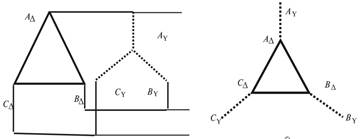
With the increasing demands of technology along with the support of modern power electronic circuits and control techniques, the world has researched, manufactured and tested many types of asynchronous motors with more than 3 phases, (multiphase motors) and some types of combined polyphase motors. However, this type of electric motor has not yet become popular, although research on them has been going on for a long time. In Vietnam, research documents on this type of motor have almost not been found. This document focuses on the research of 6-phase motors and is connected in combination with 3-phase star and 3-phase delta, so it is called a motor with combined windings connected in parallel as shown in Figure 1a.
a b
Figure 1: Two basic connection types of the combined star–delta winding
a) parallel connection, b) series connection
Theoretically, the use of a combined stator winding instead of a conventional winding can help reduce the power loss in the winding, while limiting additional losses due to the influence of high-order harmonic components [1, p.352]. On that basis, this study was carried out to evaluate the impact of the combined stator winding structure on the energy characteristics of the induction motor.
The winding is connected and arranged in such a way that the number of phase zones is doubled. The phases of the “star” and “delta” windings are spatially displaced by an angle of q = 30°, and the corresponding three-phase “star” and “delta” currents are also phase-shifted in time by the same angle q. This, as shown in [2, p.105], allows for an increase in the distribution coefficient and a reduction in differential scattering. As a result, the efficiency and power factor increase, and the current consumed from the grid is reduced. Many studies have shown that the magnetic field in the air gap of a conventional motor has a stepped waveform. As a result, numerous harmonic components appear, causing motor vibration and braking torque, which negatively affect the motor and reduce its efficiency. When the load differs from the rated value, the motor’s characteristics deteriorate significantly, and both the power factor and efficiency decrease. The motor’s magnetic field waveform with combined windings is closer to a sinusoidal shape (Figure 3) than that of a traditional 3-phase induction motor (Figure 2). As a result, with less energy consumption, without changing the existing technology and under the same equivalent working conditions, we see that the characteristics of the asynchronous motor with combined windings are significantly superior [3, p. 55].
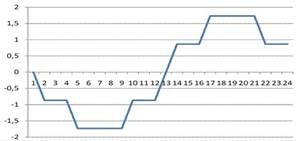
Figure 2. Field shape in the gap of conventional asynchronous motor
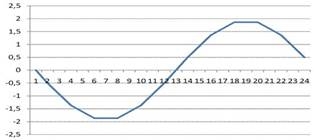
Figure 3. Field shape in the gap of a motor with combined windings
From a theoretical perspective, the authors of the works cited above mainly considered the total electromotive force (EMF) of the air-gap magnetic field in terms of calculating the amplitudes of higher-order harmonics and determining their winding factors. However, in the listed works, no method was provided for calculating the parameters of an asynchronous motor with a combined winding, which complicates their research [4, p.351].
2. Materials and methods
The study was conducted by comparing the prototype АИР100S2 asynchronous motor with an improved motor using a combined winding stator . In the improved model, the entire original winding stator of the АИР100S2 motor was utilized and rewinded according to the combined winding structure to investigate the influence of the winding method on the operating characteristics of the machine. The star winding stator already in the prototype motor is called the base winding stator . From the motor's base winding stator parameters, the combined winding stator s are determined in turn according to the following steps:
- Equivalently convert all windings into star connection.
- Number of parallel branches a=1. (In the combined winding, the number of parallel branches will be a=1/1).
- Determine the starting point of the combined winding
|
|
(1) |
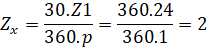
Star winding installation should start from the first slot, while delta winding installation should start from the third slot.
- Calculating the number of turns of the start winding
|
|
(2) |
 76 turns
In which NY is the number of turns of the star winding, NB is the number of turns of the base winding.
WB = WY The number of turns in 1 phase of the star winding is equal to the number of turns of the base winding.
- Calculate the number of turns in the delta winding
|
|
(3) |

rounded to 132 turns
The cross-section of the delta winding is calculated
|
|
(4) |

Thus diameter of the delta winding d = 0.95 mm.
The cross- section of the delta winding is calculated as follows:
|
|
(5) |

The wire diameter of the delta winding is calculated as d= 0.72 mm.
Check the filling of the winding slot of the combination winding.
|
|
(6) |

Area of wire in the slot of combination winding: (0,7822.38)+ (66*0,4097) =53,8
Area of wire in the slot of the prototype motor: 38*0,708822*2 =53,9
Thus, the winding cross-section of the combination winding is still smaller than that of the original motor, allowing all windings of both star and delta to be inserted into the motor slot without overflow.
From the above expressions and based on the parameters of the original motor, the technical parameters of the motor with the combination winding are presented in Table 1.
Table 1.
Technical parameters of the АИР100S2 combination motor
|
Parameter |
Symbol |
Unit |
Value |
|
Rated power |
P |
kW |
4 |
|
Rated voltage |
U |
V |
220 / 380 |
|
Rated current |
I |
A |
8.1 |
|
Number of conductors per slot |
n |
- |
- |
|
Star winding |
|
|
64 turns |
|
Delta winding |
|
|
110 turns |
|
Bare wire diameter (without insulation) |
d |
mm |
- |
|
Prototype winding |
|
mm |
0.90 |
|
Combined winding |
|
mm |
0.68 |
|
Number of parallel branches |
a |
- |
1 |
|
Winding stator pitch |
y |
- |
1–12 |
|
Outer diameter of stator core |
Da |
mm |
150 |
|
Inner diameter of stator core |
Di |
mm |
83 |
|
Stator core length |
L1 |
mm |
130 |
|
Number of stator slots |
Z1 |
- |
24 |
|
Number of rotor slots |
Z2 |
- |
17 |
|
Number of slots per pole per phase |
q |
- |
4 |
The induction motor with combined star-delta stator windings is constructed with two sets of three-phase windings spatially displaced by an electrical angle of 30°. The neutral points of these windings can either be isolated or interconnected in a star–delta configuration, as illustrated in Fig. 1. The detailed circuit diagram of the winding system, and the corresponding electromotive force (EMF) phasor diagram is presented in Fig. 4
|
|
|
|
a |
b |
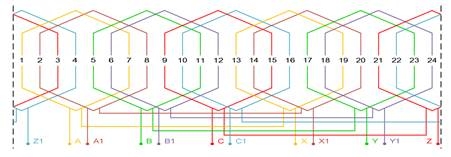
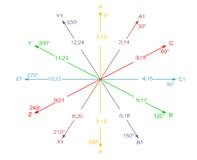
Figure 4. (a) Winding diagram; (b) Phasor diagram, of the EMF of the combined-winding motor..
The combined winding divides the 60° phase belt of a conventional three-phase machine into two sections that are spatially displaced by 30°. Slots 1–13, 7–19, 3–15, 9–21, 5–17, and 11–23 correspond to phases A, B, and C, respectively, whereas phases A₁, B₁, and C₁ are placed in slots 2–14, 8–20, 4–16, 10–22, 6–18, and 12–24. Each winding is positioned independently in its designated slots without any distribution. Consequently, the winding distribution factor increases from 0.966 in a conventional three-phase motor to 1.0 in the combined-winding motor [5, p.75].
To evaluate the operating condition of the motor under various load scenarios, steady-state numerical simulations were carried out using the electromagnetic simulation tool ANSYS Maxwell, which is based on the finite element method (FEM). In addition, an experimental model of the motor was tested in the laboratory of Nam Dinh University of Technology Education using a motor test module integrated with an electromagnetic control system. This setup allows for the control of speed and load torque, either manually or via computer interface, as illustrated in Fig. 5.
.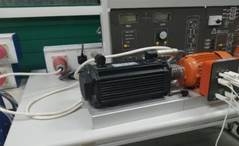
Figure 5. Experimental panel of the multifunctional motor test system
The experiments were conducted under the rated voltage condition, with the load adjusted by an electromagnetic loading device that allowed variation from no-load to rated load. Measurements were carried out to evaluate the efficiency, losses, current, torque, and operational characteristics of the motor at different load levels, thereby enabling a comparison of the performance between the two winding configurations.
The experiments were conducted under the rated voltage condition, with the load adjusted by an electromagnetic loading device that allowed variation from no-load to rated load. Measurements were carried out to evaluate the efficiency, losses, current, torque, and operational characteristics of the motor at different load levels, thereby enabling a comparison of the performance between the two winding configurations[6, p.15].
3. Results and Discussion
First, the simulation in Ansys Maxwell was conducted by setting the stator and rotor parameters according to the manufacturer’s specifications for the АИР100S2 motor and the calculated parameters for the combined-winding motor described above. The load was set to the rated torque of the motor. The simulation results show the distribution of magnetic flux density in the motor and in the air gap, as shown in figure 6.
The simulation results provide a magnetic flux density distribution in the cross-section of the asynchronous AC motor, showing a highly continuous and symmetrical magnetic field distribution, with regions of high flux density concentrated at the stator and rotor teeth. The magnetic material operates within the linear region of the magnetization characteristic; therefore, no significant local saturation occurs, ensuring that the magnetic circuit operates within safe limits.
|
|
|
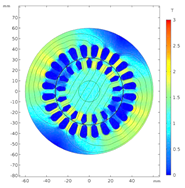
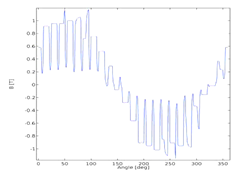
Figure 6 Magnetic flux density (a) in the motor and (b) in the air gap
The magnetic flux density in the air gap is distributed stably along the circumference, contributing to maintaining an almost constant electromagnetic torque during rotation, thereby minimizing torque ripple and mechanical vibration of the motor.
|
|
|
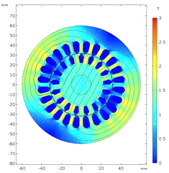
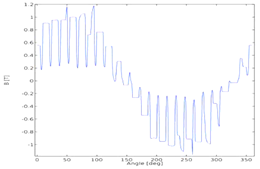
Figure 7. Magnetic flux density distribution when the number of winding turns is reduced:
(a) within the motor core and (b) across the air gap
To evaluate the effect of the inaccuracy of the ratio of the number of windings in the combined motor, the setting of the number of turns of the delta winding was changed from 110 to 103 turns. The simulation results obtained the cross section of the magnetic flux density in the motor and in the air gap (figure 7).
Observing figure 7, the overall shape is similar to that in figure 6, but the magnetic flux in the rotor tooth area is slightly deviated and there are signs of flux center displacement. The magnetic field distribution in the iron core and air gap is deformed; the magnetic field is deviated, and the local saturation zone is expanded. These phenomena clearly reflect the interaction between the armature magnetic field components, which directly influences the electromagnetic torque and torque ripple of the motor.
When the simulation was performed under no-load conditions, similar results were obtained. This indicates that small deviations in the number of turns between the star- and delta-connected stator windings have negligible effects on the stator current and the magnetic field distribution within the machine. However, larger deviations in the turn ratio lead to more significant variations in both electrical and magnetic quantities.
Experimental tests were conducted on both the prototype and the combined motors using the experimental module described in figure 8. The motors were operated under steady-state conditions, and measurement procedures were carefully carried out to minimize errors. The recorded data were then imported into Microsoft Excel for processing and graphical representation of the correlations among the motor parameters.
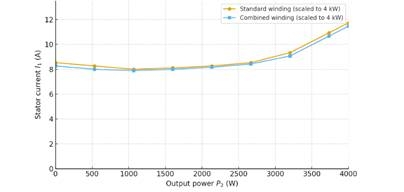
Hình 8. Dependence of stator current on shaft power
The combined winding configuration demonstrates a more efficient utilization of the stator current, particularly in the high-power operating region, due to the optimal combination of the two winding systems - star and delta. These results indicate that employing the combined winding structure can reduce the stator current, improve the power factor, and enhance the overall efficiency of the motor under the same output power conditions.
4. Conclusion
This study presents the design method and experimental evaluation of an induction motor employing a star–delta combined stator winding. The results of finite element simulation and experiment show that the combined winding configuration significantly improves the motor’s energy characteristics compared with the conventional winding.
Specifically, the magnetic flux density in the air gap of the combined motor is closer to a sinusoidal waveform, which contributes to the reduction of high-order harmonic components, stabilization of electromagnetic torque, and suppression of mechanical vibrations. Furthermore, experimental measurements demonstrate that the stator current and reactive power are reduced, while the overall efficiency of the motor increases by 2–3.7% at the same output power level, with the power factor remaining almost unchanged. These findings confirm the feasibility and effectiveness of the combined winding structure in enhancing energy efficiency and reducing electromagnetic losses in three-phase induction motors.
References:
- Geller B. Higher harmonics in asynchronous machines / B. Geller, V. Gamata; edited by Z. G. Kaganova // Energy - 1981. – С. 352. [in Russian].
- Kasten H. Combined stator windings in electric machines with same coils/ H. Kasten, W. Hofmann // 2012 XXth International Conference on Electrical Machines. - Marseille, France – 2012. - P. 103-108.
- Afanasyev A.A. Combined winding "Slavyanka" / A.A. Afanasyev, V.M. Nikitin, D.A. Tomakov // Electricity. – 2017. – № 6. – С. 55. [in Russian]
- Cistelecan M. V. Adjustable flux three-phase ac machines with combined multiple-step star-delta winding connections / M. V. Cistelecan, F. J. T. E. Ferreira, M. Popescu // IEEE Transactions on Energy Conversion. – 2010. – № 2. – Р. 348-355.
- Martynov, K. V. Methodology for recalculating an asynchronous motor for a combined stator winding / K. V. Martynov, V. A. Noskov // Innovations in agriculture. – 2018. – № 3 (28). – С. 71-77. [in Russian].
- Kosmatov, V. I. Research of load modes of electric drives with an asynchronous motor with two windings on the stator / V. I. Kosmatov, A. S. Sarvarov, E. I. Danilov // Electrical systems and complexes. – 2018. – № 2(39). – С. 12-17. [in Russian].
дипломов