
Статья опубликована в рамках: CXI Международной научно-практической конференции «Актуальные вопросы экономических наук и современного менеджмента» (Россия, г. Новосибирск, 07 октября 2026 г.)
Наука: Экономика
Секция: Инновационные подходы в современном менеджменте
Скачать книгу(-и): Скачать книгу
дипломов
DIGITAL TRANSFORMATION AS AN ENABLER OF INTELLIGENT ENTERPRISE ARCHITECTURE: ROLE OF ERP, AI, AND IOT

ABSTRACT
Background. Enterprise Resource Planning (ERP) systems, long the backbone of organizational data integration, are being reshaped by the convergence of artificial intelligence (AI) and the Internet of Things (IoT), giving rise to what practitioners and researchers increasingly describe as “intelligent enterprise architecture”: an architecture that not only integrates enterprise data but interprets it and acts on it in real time. This article examines the role of ERP, AI, and IoT integration as an enabler of intelligent enterprise architecture, quantifies the size and growth rate of the underlying ERP, AI, and IoT technology markets, and analyzes the organizational barriers that continue to separate the technological potential of this convergence from its realized value.
Methods. A mixed literature-based and market-analytical method is used, synthesizing enterprise-architecture theory (principally the TOGAF framework), recent peer-reviewed and industry research on AI-enhanced ERP systems (2023–2026), empirical statistics on digital transformation and ERP implementation outcomes, and a quantitative market-sizing analysis drawn from six 2025-vintage industry-analytics and survey sources covering the global AI, ERP-software, IoT, AI-in-ERP, and digital-transformation-spending markets, together with a large-sample global AI-adoption survey.
Results. Four findings structure the analysis. First, the technology markets underlying intelligent enterprise architecture are large and growing quickly: the global AI market (US$294.16 billion in 2025) and the AI-in-ERP sub-segment (US$5.82 billion in 2025) are forecast to grow at 26–27% CAGR — roughly twice the 13% CAGR forecast for core ERP software — indicating that the AI layer, not the ERP backbone, is the fastest-moving part of the stack. Second, enterprise architecture frameworks such as TOGAF provide the structural language — business, data, application, and technology architecture layers — within which ERP, AI, and IoT integration must be planned to avoid producing disconnected point solutions; case evidence from SME and banking-sector TOGAF adoption indicates the framework's applicability beyond the large-enterprise context for which it was originally developed. Third, the shift from “rules-based” to “learning-based” ERP represents the substantive technical change underlying the intelligent-enterprise-architecture concept, with IoT and edge-computing integration extending this capability to physical assets. Fourth, and most directly responsive to the gap this revision addresses, a large-sample 2025 global survey quantifies the adoption-to-impact gap precisely: 88% of organizations now use AI in at least one business function, yet only 39% report any enterprise-level EBIT impact from it, only 7% have fully scaled AI enterprise-wide, and only 6% qualify as high performers capturing material (≥5% of EBIT) value — numeric confirmation that technology adoption and realized organizational value are two distinct and widely separated variables, consistent with ERP-specific implementation failure rates commonly cited in the 50–75% range.
Conclusion. Digital transformation enables intelligent enterprise architecture technically, and the underlying AI, ERP, and IoT markets are well capitalized and expanding rapidly; but realization depends on treating ERP-AI-IoT integration as an architectural and organizational transformation governed by an explicit enterprise architecture framework, rather than as a sequence of point-technology deployments layered onto an unchanged organizational structure — a case, the quantitative evidence shows, of market growth substantially outpacing organizational absorption.
Keywords: digital transformation; enterprise architecture; TOGAF; ERP; artificial intelligence; Internet of Things; intelligent enterprise; change management; system integration; market analysis.
Introduction
Enterprise Resource Planning systems were designed to solve a specific integration problem: replacing fragmented departmental databases with a single, shared record of an organization's transactions, inventory, and finances. That problem is now largely solved in most mid-size and large organizations, but a second integration problem has taken its place — connecting the static transactional record that ERP provides to the dynamic streams of data generated by artificial intelligence models and Internet of Things (IoT) sensors, and doing so within an architecture that the organization can actually govern, secure, and evolve. Traditional ERPs “rely on rules and react to inputs, requiring manual data entry and set procedures,” whereas AI-enhanced ERPs “analyze past and real-time data to identify patterns and suggest suitable solutions” [5] — a shift from a rules-based to a learning-based system that is frequently described as the central value proposition of this convergence, including for small and medium-sized enterprises seeking scalable, cost-effective digital transformation.
This convergence is occurring inside a technology market whose scale this article now quantifies directly. The global AI market was valued at US$294.16 billion in 2025 and is projected to reach US$2,480.05 billion by 2034, a 26.60% compound annual growth rate (CAGR) [15]; the global ERP software market, by contrast, was valued at US$92.6 billion in 2025 and is forecast to grow at a comparatively modest 13.0% CAGR to US$281.58 billion by 2034 [16]. The AI-in-ERP sub-segment specifically — the technical locus of the “intelligent enterprise architecture” this article examines — was valued at only US$5.82 billion in 2025 but is forecast to grow at 26.00% CAGR to US$58.7 billion by 2035 [18], nearly matching the growth rate of the AI market overall and roughly double that of core ERP. This asymmetry — a small but fast-growing AI-in-ERP layer sitting on top of a large but slower-growing ERP base — is a market-level signature of exactly the technical shift the literature describes qualitatively: intelligence, not core transaction processing, is where investment and growth are concentrated.
This convergence also does not occur in an architectural vacuum. Enterprise Architecture (EA), and specifically the widely adopted TOGAF framework, exists precisely to prevent digital transformation from producing a collection of disconnected point solutions by formally defining an organization's business processes, information systems, technology infrastructure, and the interrelationships among them [1]. Yet despite the maturity of both the EA discipline and the underlying AI/IoT technology — and despite global digital transformation spending on track to reach US$3.4 trillion in 2026 [19] — digital transformation initiatives continue to fail at rates that industry and academic sources place between roughly 70 and 90 per cent against their original objectives, with average costs to organizations estimated in the trillions of dollars annually [10]. A large-sample 2025 global survey puts a sharper number on this same pattern: 88% of organizations now use AI in at least one business function, but only 39% report any enterprise-level profit impact from it, and only 7% have fully scaled AI enterprise-wide [20]. This gap between technical and market maturity on one hand, and delivered organizational value on the other, is the empirical puzzle this article addresses.
The objective of the article is to examine how digital transformation — specifically the integration of ERP, AI, and IoT — functions as an enabler of intelligent enterprise architecture, to quantify the scale and growth trajectory of the markets that make this technically possible, and to identify why this technical and commercial maturity so frequently fails to translate into realized organizational value. The article does not propose a new architecture or technology; it synthesizes enterprise-architecture theory, current market-sizing and survey data, and recent empirical literature to characterize the current relationship between technological capability, market growth, and organizational outcome.
Theoretical Framework
TOGAF defines Enterprise Architecture as a comprehensive approach formally defining an organization's core components — business processes, information systems, technology infrastructure, and their interrelationships — and offering a structured methodology, the Architecture Development Method (ADM), for designing, planning, implementing, and governing an enterprise's architecture across ten loosely ordered phases [2]. Four architecture domains are conventionally distinguished within this framework: business architecture (processes and organizational structure), data architecture (information assets and their management), application architecture (the individual systems, including ERP, CRM, and AI platforms), and technology architecture (the infrastructure — cloud, edge computing, IoT networks — on which applications run) [2]. “Intelligent enterprise architecture,” as used in the recent practitioner and academic literature, describes the state in which AI and IoT capabilities are embedded across these four domains rather than confined to isolated application-layer tools — for example, AI-based chatbots integrated with customer-service systems, machine-learning modules embedded within inventory management, and IoT-edge computing convergence feeding real-time data into ERP-based decision processes [7].
This framework generates the article's guiding propositions, extended here to incorporate the market and survey evidence presented in the Results section. P1: the technical capability for intelligent enterprise architecture — AI-enhanced ERP combined with IoT sensing — is already mature and commercially available at scale, as evidenced by a US$294 billion global AI market and a US$865 billion global IoT market in 2025, such that unrealized value cannot be primarily attributed to a technology or market-supply gap. P2: enterprise architecture frameworks such as TOGAF, while historically associated with large enterprises, are increasingly documented as applicable to SMEs, suggesting that firm size is not by itself the binding constraint on intelligent-architecture adoption. P3: the dominant cause of digital transformation failure in this domain is organizational — change management, user adoption, and cross-system integration complexity — rather than a deficiency in AI model performance or IoT connectivity, a proposition the 88%-adoption-versus-39%-impact gap documented in the Results section quantifies directly rather than merely asserting.
Materials and Methods
This article uses a mixed literature-based and market-analytical method combining four source types: (i) enterprise-architecture theory and framework documentation, principally TOGAF and its application literature; (ii) peer-reviewed and industry research on AI-enhanced and IoT-integrated ERP systems published between 2023 and 2026; (iii) empirical statistics on digital transformation and ERP implementation success and failure rates drawn from industry research organizations (Gartner, McKinsey, Bain, BCG) as reported in recent secondary literature; and (iv) a quantitative market-sizing analysis drawing on six 2025-vintage industry-analytics reports (Fortune Business Insights, Precedence Research, IDC) covering the global AI, ERP-software, IoT, AI-in-ERP, and digital-transformation-spending markets, together with McKinsey's large-sample global State of AI in 2025 survey, used to establish the scale, growth rate, and adoption-to-impact gap discussed qualitatively elsewhere in the article. Because failure-rate statistics in this domain vary considerably by source, definition, and methodology, the article reports the range of cited figures rather than treating any single statistic as definitive, and treats convergence across independent sources — rather than any one number — as the more reliable indicator of the underlying pattern.
Results
Market context: the scale of the ERP, AI, and IoT markets
The enterprise-architecture and implementation-failure findings that follow sit within a technology market whose scale and growth rate this article now quantifies directly, addressing a gap in the qualitative literature this review otherwise draws on. Table 1 and Figure 1 summarize market-sizing estimates for the five segments most directly relevant to ERP-AI-IoT convergence.
Table 1.
Market size, forecast horizon, and compound annual growth rate (CAGR) for the technology segments underlying intelligent enterprise architecture, 2025 estimates. Sources: [15]–[19].
|
Segment |
2025 market size |
Forecast (horizon year) |
CAGR |
Source |
|---|---|---|---|---|
|
Global artificial intelligence |
US$294.16 billion |
US$2,480.05 billion (2034) |
26.60% |
[15] |
|
Global ERP software |
US$92.6 billion |
US$281.58 billion (2034) |
13.0% |
[16] |
|
Global IoT |
US$864.32 billion |
US$5,552.48 billion (2034) |
23.10% |
[17] |
|
AI in ERP |
US$5.82 billion |
US$58.7 billion (2035) |
26.00% |
[18] |
|
Global digital transformation spending |
≈ US$2.6 trillion |
US$3.4 trillion (2026) |
16.3% (5-yr) |
[19] |
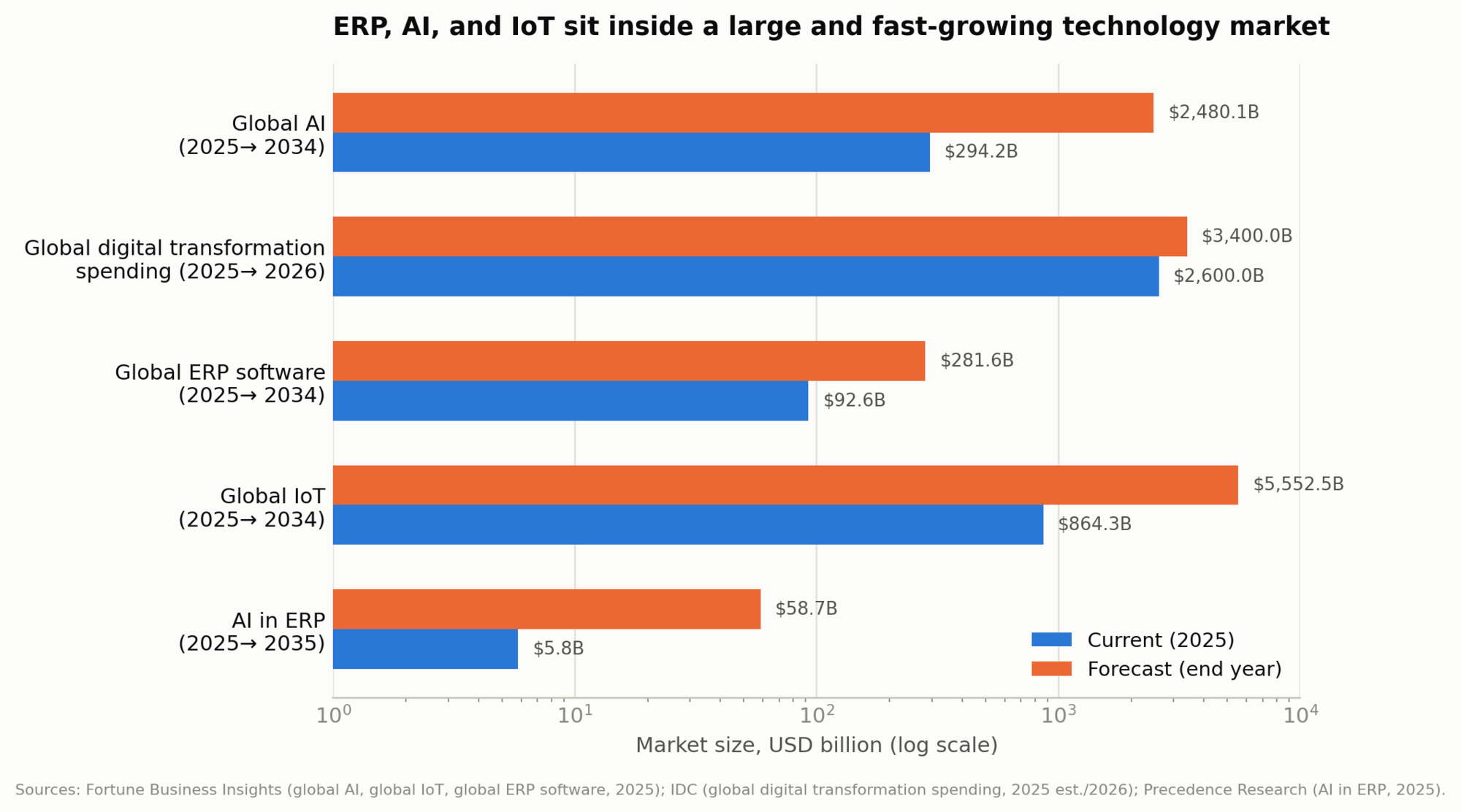
Figure 1. Current (2025) and forecast market size by technology segment, log scale. Sources: [15]–[19]
The pattern in Table 1 is analytically significant for Proposition P1. The global ERP software market — the transactional backbone this article's argument centers on — is both large (US$92.6 billion in 2025) and, relative to the other segments, the slowest-growing at 13.0% CAGR, consistent with a mature, largely commoditized software category. The AI market as a whole (26.60% CAGR) and the AI-in-ERP sub-segment specifically (26.00% CAGR) are growing roughly twice as fast, as shown in Figure 2, even though AI-in-ERP remains two orders of magnitude smaller in absolute terms (US$5.82 billion versus US$92.6 billion in 2025).
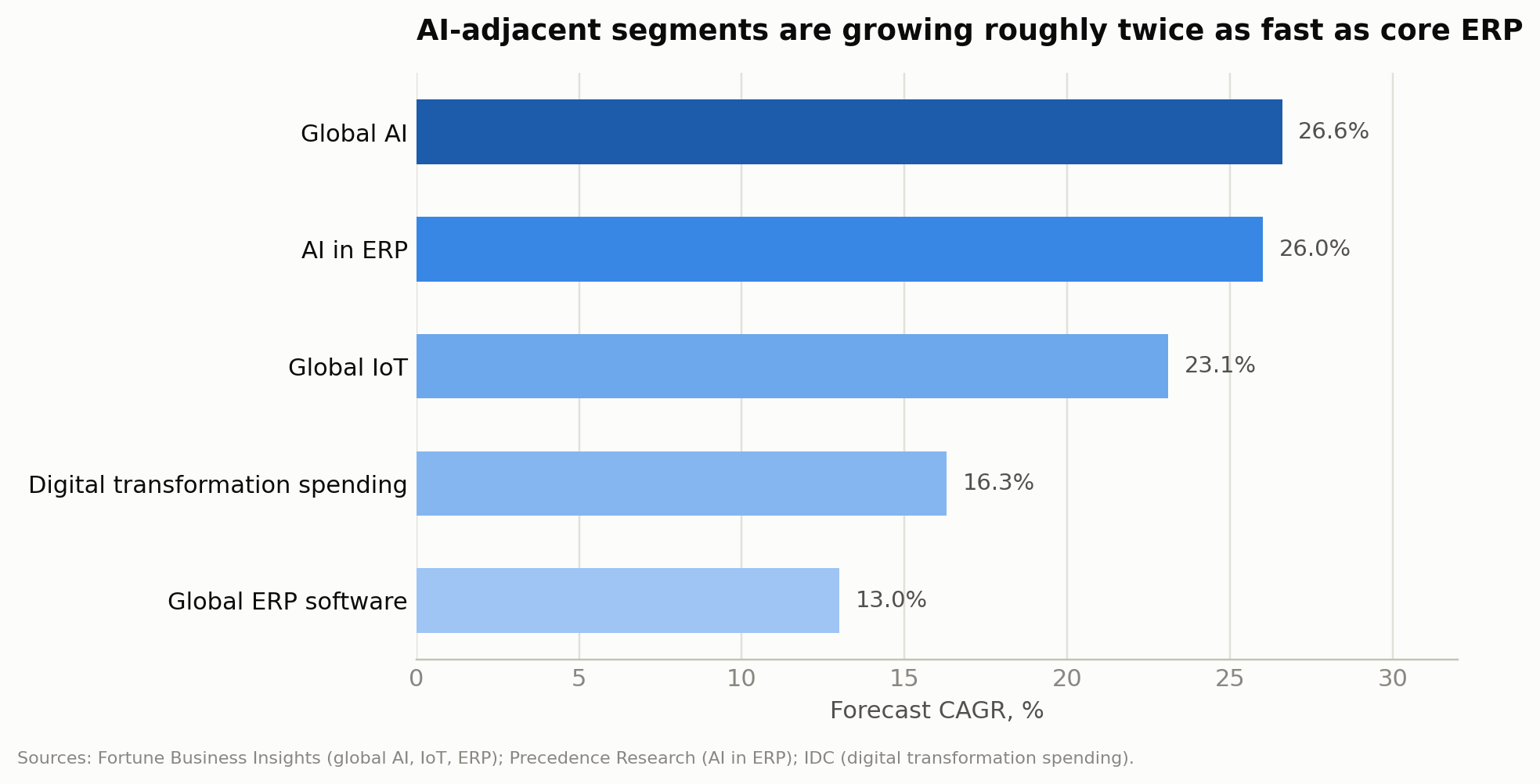
Figure 2. Forecast compound annual growth rate by technology segment, sorted ascending. Sources: [15]–[19]
This is the market-level signature of the qualitative shift documented in the following subsection: investment and growth are concentrated in the intelligence layer rather than the transactional core, even though the transactional core remains, in absolute dollar terms, the larger market today. Global digital transformation spending as a whole — on track to reach US$3.4 trillion in 2026, growing at a five-year CAGR of roughly 16.3% [19] — is large enough to fund this shift at the level of the world economy; the question this article's remaining Results subsections address is why that capital and technology supply so frequently fails to convert into realized value at the level of the individual organization.
Enterprise architecture as the structuring layer
Empirical case research indicates that TOGAF's Architecture Development Method is not confined to large enterprises: a design-science-research study applying a TOGAF 10-based framework to digital transformation in SME banks found the methodology adaptable to small-scale financial institutions' specific constraints, using case studies, interviews, and document analysis to validate the resulting architecture [3]. A systematic review of enterprise architecture's role in SME digital transformation, conducted under PRISMA 2020 guidelines, similarly found that frameworks including TOGAF, Zachman, and the Federal Enterprise Architecture Framework (FEAF) support alignment of IT capability with organizational goals, and specifically identified AI and cloud computing as the emerging technologies with the greatest transformative impact on decision-making, scalability, and agility within an EA-governed transformation [4]. This evidence supports Proposition P2: the constraint on intelligent-architecture adoption is not organizational scale but whether a governing architectural framework is applied at all.
The technical shift: rules-based to learning-based ERP
The substantive technical change underlying “intelligent enterprise architecture” is the shift of ERP systems from static, rules-based transaction processors to dynamic, learning-based systems capable of pattern recognition and real-time recommendation [5]. The AI-in-ERP market's 26.00% forecast CAGR through 2035 [18] is the commercial expression of this same shift: vendors and enterprises are investing in the analytical layer at nearly double the rate of the underlying ERP platform market. Industry analysis of ERP development trends for 2025 and beyond identifies IoT and Industrial IoT (IIoT) integration as a specific direction of this shift, with ERP systems increasingly leveraging edge computing and digital twins to enable real-time monitoring and predictive maintenance rather than retrospective reporting alone, alongside a parallel trend toward role-based system personalization and stronger AI-governance frameworks as AI becomes integral to automated decision-making [8]. At the integration-architecture level, the broader trend is a move from point-to-point middleware toward API-first and event-driven enterprise integration: a 2025 industry survey found 82 per cent of organizations had adopted some level of API-first architecture, with AI agents increasingly emerging as autonomous consumers that discover and invoke enterprise system capabilities directly, a structural shift that a leading analyst firm's 2025 research on ERP event-driven integration flags as introducing new reliability and governance challenges of its own [9]. This confirms Proposition P1: the underlying AI and IoT technology enabling intelligent enterprise architecture is mature, in active commercial deployment, and backed by a fast-growing dedicated market segment.
The persistence of implementation failure: quantifying the adoption-to-impact gap
Despite this technical and market maturity, digital transformation and ERP implementation failure rates remain high and are reported consistently across independent sources. A 2026 industry analysis places digital transformation failure at approximately 70 per cent against stated objectives, with a Gartner survey cited as finding only about 48 per cent of projects fully meeting or exceeding targets, and a separate 2024 study finding 88 per cent of business transformations fail to achieve their original ambitions [10]. ERP-specific sources report implementation failure rates exceeding 50 per cent on first attempt, with cost overruns commonly reported in the range of three to four times original budget and a separate estimate that 47 per cent of ERP implementations experience budget overruns averaging 35 per cent over plan [11, 13].
McKinsey's large-sample global State of AI in 2025 survey allows this pattern to be quantified as a single adoption-to-impact funnel rather than a set of separately sourced ranges, summarized in Table 2 and Figure 3 [20].
Table 2.
The AI adoption-to-impact gap, global survey, November 2025. Source: [20].
|
Stage |
Share of organizations |
Source |
|---|---|---|
|
Use AI in at least one business function |
88% (up from 78% the prior year) |
[20] |
|
Report any enterprise-level EBIT impact from AI |
39% |
[20] |
|
Have fully scaled AI enterprise-wide |
7% |
[20] |
|
Qualify as “AI high performers” (≥5% of EBIT) |
6% |
[20] |
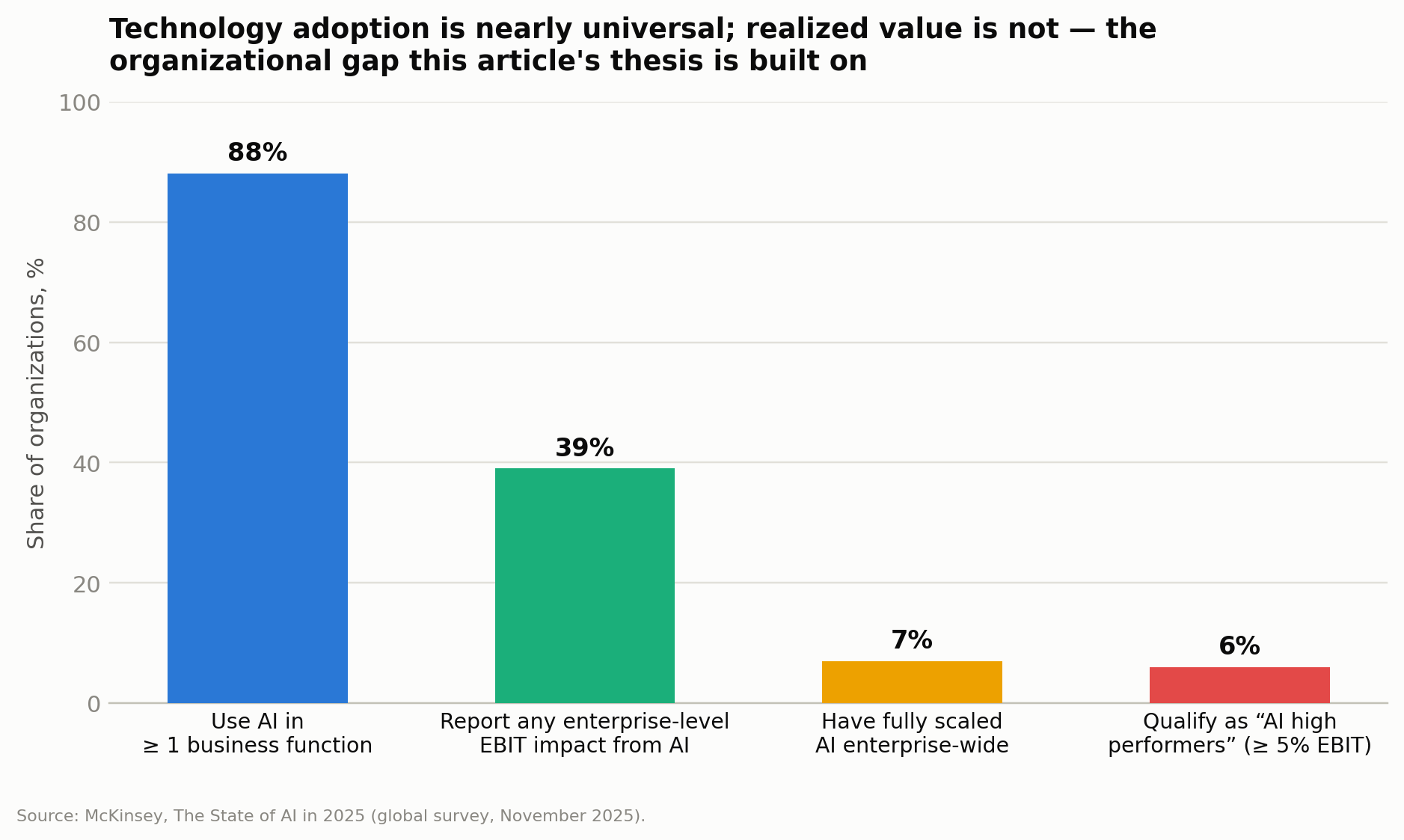
Figure 3. Share of organizations at each stage from AI adoption to measurable, scaled financial impact. The 49-percentage-point drop between “use AI in at least one function” (88%) and “report any EBIT impact” (39%) is the clearest available quantitative evidence that adoption and realized value are distinct variables. Source: McKinsey, The State of AI in 2025 [20]
This funnel is the single most direct piece of evidence in support of Proposition P3. Eighty-eight per cent adoption confirms that AI is not a scarce or hard-to-access technology — consistent with the US$294 billion global AI market documented in Table 1 — yet the 49-percentage-point drop to only 39% reporting any enterprise-level profit impact, and the further collapse to 7% fully scaled and 6% classified as high performers, cannot be explained by technology unavailability. Notably, organizations that engage specialized ERP implementation consultants report an 85 per cent success rate, a gap that points toward implementation methodology and organizational readiness, rather than the software itself, as the decisive factor [12]. Analysis of SME-specific ERP failures similarly attributes outcomes to organizational factors — an owner's personal stance toward change functioning as a determining variable in the absence of a large enterprise's formal steering-committee governance — rather than to technical inadequacy of the ERP platform [14], directly supporting Proposition P3.
Discussion
Read together, these findings describe a specific and somewhat counterintuitive pattern: the technology required for intelligent enterprise architecture is mature, commercially well-resourced, and growing at 23–27% CAGR across its AI and IoT components, and the architectural frameworks (TOGAF and its relatives) required to structure that technology's deployment are well established and demonstrably adaptable beyond their original large-enterprise context — yet the observed failure rate for the transformations meant to combine them remains stubbornly high across multiple independent measurement efforts, and the McKinsey adoption-to-impact funnel shows this is not a measurement artifact of any single source: 88% adoption collapses to single-digit percentages of organizations capturing material financial value. The most parsimonious explanation consistent with the evidence is that intelligent enterprise architecture is fundamentally a change-management and governance problem wearing the appearance of a technology problem: AI models and IoT sensors can be procured and deployed relatively quickly, and the market data in Table 1 shows the supply side of that procurement is large and expanding, but the business-process redesign, user retraining, and cross-departmental data governance that must accompany them cannot be compressed to the same timescale or purchased at the same speed as the underlying software.
This has a direct implication for how ERP-AI-IoT integration should be planned. Where an organization treats AI and IoT capability as features to be added to an existing ERP deployment, the evidence reviewed here suggests a high probability that the addition will function as an isolated point solution — a chatbot bolted onto customer service, a predictive-maintenance dashboard disconnected from procurement — rather than as an integrated capability across the business, data, application, and technology architecture layers that TOGAF specifies. This is precisely the pattern implied by a market in which the AI-in-ERP segment (26.00% CAGR) is growing far faster than organizations' demonstrated capacity to convert AI use into scaled, measured impact (7% fully scaled, per Table 2): the purchasing and deployment side of the market is outrunning the organizational-absorption side. Where an organization instead treats the ERP-AI-IoT convergence as an occasion to revisit its enterprise architecture as a whole, the SME-banking and systematic-review evidence suggests materially better alignment between technical capability and organizational goals, even at smaller organizational scale.
Four limitations qualify these conclusions. First, the failure-rate statistics cited in this literature vary considerably in definition and methodology across sources (Gartner, McKinsey, Bain, and various industry blogs), and the article has reported this range rather than resolving it; a more rigorous synthesis would require harmonizing these definitions before drawing firm quantitative conclusions. Second, most of the enterprise-architecture case evidence reviewed here concerns SME banking specifically; whether similar findings generalize to manufacturing, logistics, or public-sector organizations — where IoT integration with physical assets is typically more central — remains an open question for further case research. Third, because AI-ERP integration is evolving rapidly, with API-first and event-driven architectures still an emerging rather than settled practice as of 2025–2026, some of the architectural patterns discussed here may be superseded by subsequent developments. Fourth, the market-sizing and survey figures added to this revision are vendor-analyst forecasts and a single (albeit large-sample) survey organization's data; they establish market scale and a documented adoption-to-impact gap, not audited financial returns on any individual organization's ERP-AI-IoT investment, and this article does not claim otherwise.
Conclusion
This article has examined digital transformation — specifically the integration of ERP, AI, and IoT — as an enabler of intelligent enterprise architecture, situating that examination within TOGAF's structural framework for aligning business, data, application, and technology architecture, and within the scale of the global technology markets that make it commercially feasible. The evidence indicates that the underlying technology and its supporting market are both mature: the global AI market was valued at US$294 billion in 2025 and is forecast to grow at 26.60% CAGR, the global IoT market at US$864 billion is forecast to grow at 23.10% CAGR, and the AI-in-ERP sub-segment specifically is forecast to grow at 26.00% CAGR — roughly double the 13.0% CAGR of core ERP software [15–18]. ERP systems have demonstrably shifted from rules-based transaction processors to learning-based systems capable of real-time pattern recognition, and IoT-edge integration extends this capability to physical assets through predictive maintenance and continuous monitoring. Enterprise architecture frameworks capable of governing this convergence are similarly mature and, contrary to their historical association with large enterprises, are documented as adaptable to SME contexts.
The principal finding, now quantified rather than merely asserted, is that the persistent, high failure rate of digital transformation initiatives in this domain is best explained by organizational and change-management factors rather than by any deficiency in AI or IoT technology itself: 88% of organizations use AI in at least one function, yet only 39% report any enterprise-level profit impact and only 7% have fully scaled it [20]. The practical implication is that the intelligent-enterprise-architecture agenda is served less by acquiring additional AI or IoT point solutions — the market already supplies these abundantly and at falling relative cost — and more by applying an explicit enterprise architecture methodology: clarifying business objectives, redesigning affected processes, and governing data and application integration deliberately before or alongside technology deployment, a sequencing that the SME and systematic-review evidence associates with meaningfully better transformation outcomes.
References:
- Chaudhry R. Enterprise Architecture as a Strategic Driver for Digital Transformation and Agility [Electronic resource] // Medium. — 2025. — URL: https://medium.com/razi-chaudhry/enterprise-architecture-as-a-strategic-driver-for-digital-transformation-and-agility-ea-part-1-ffcd60dcf598 (date of access: 25.08.2026).
- Ardoq. What Is TOGAF? Definition and Uses of This EA Framework [Electronic resource]. — 2025. — URL: https://www.ardoq.com/knowledge-hub/togaf (date of access: 25.08.2026).
- A TOGAF 10-Based Enterprise Architecture Framework for Digital Transformation in SME Banks [Electronic resource]. — 2025. — URL: https://www.researchgate.net/publication/391841912 (date of access: 25.08.2026).
- The Role of Enterprise Architecture for Digital Transformations: A Systematic Review [Electronic resource]. — 2021. — URL: https://www.researchgate.net/publication/349428662 (date of access: 25.08.2026).
- AI-Enhanced ERP Systems: Transforming Enterprise Operations through Intelligent Integration [Electronic resource]. — 2025. — URL: https://www.researchgate.net/publication/396362452 (date of access: 25.08.2026).
- Transforming ERP Systems with Collaborative AI: Paving the Path to Strategic Growth and Sustainability // ScienceDirect [Electronic resource]. — 2025. — URL: https://www.sciencedirect.com/science/article/pii/S2590005625001444 (date of access: 25.08.2026).
- TTMS. AI in Digital Transformation Strategy 2025: 6 Key Trends for Large Companies [Electronic resource]. — 2025. — URL: https://ttms.com/ai-in-digital-transformation-strategy-6-key-trends-for-large-companies/ (date of access: 25.08.2026).
- Washington Frank. How ERP Systems Are Leveling Up in 2025: The Future of AI, Automation, and Industry-Specific Solutions [Electronic resource]. — 2025. — URL: https://www.washingtonfrank.com/insights/how-erp-systems-are-leveling-up-in-2025 (date of access: 25.08.2026).
- Qentelli. Future of Enterprise Integration: API-First and Event-Driven [Electronic resource]. — 2026. — URL: https://qentelli.com/insights/blogs/the-future-of-enterprise-integration-api-first-event-driven-and-beyond/ (date of access: 25.08.2026).
- MeltingSpot. Digital Transformation Failure Rate 2025: Why 70% of Projects Still Fail [Electronic resource]. — 2026. — URL: https://meltingspot.io/en/blog/why-digital-transformation-projects-fail (date of access: 25.08.2026).
- Pemeco Consulting. Why ERP Implementation Failures Exceed 50% Rates [Electronic resource]. — 2026. — URL: https://pemeco.com/two-big-reasons-erp-implementation-failure/ (date of access: 25.08.2026).
- RubinBrown ERP Advisory Services. Top ERP Insights & Statistics [Electronic resource]. — 2025. — URL: https://kpcteam.com/kpposts/top-erp-statistics-trends (date of access: 25.08.2026).
- Integrate.io. Data Transformation Challenge Statistics — 50 Statistics Every Technology Leader Should Know in 2026 [Electronic resource]. — 2026. — URL: https://www.integrate.io/blog/data-transformation-challenge-statistics/ (date of access: 25.08.2026).
- Initos. ERP Implementation: The Ultimate 7 Factors to Avoid [Electronic resource]. — 2025. — URL: https://www.initos.com/en/blog/what-to-avoid-in-erp-implementation-project/ (date of access: 25.08.2026).
- Artificial Intelligence Market Size, Share — Global Report [Electronic resource] // Fortune Business Insights. — 2025. — URL: https://www.fortunebusinessinsights.com/industry-reports/artificial-intelligence-market-100114 (date of access: 22.09.2026).
- Enterprise Resource Planning (ERP) Software Market Size [Electronic resource] // Fortune Business Insights. — 2025. — URL: https://www.fortunebusinessinsights.com/enterprise-resource-planning-erp-software-market-102498 (date of access: 22.09.2026).
- Internet of Things (IoT) Market Size, Share & Industry Analysis [Electronic resource] // Fortune Business Insights. — 2025. — URL: https://www.fortunebusinessinsights.com/industry-reports/internet-of-things-iot-market-100307 (date of access: 22.09.2026).
- AI in ERP Market Size to Hit USD 58.7 Billion by 2035 [Electronic resource] // Precedence Research. — 2025. — URL: https://www.precedenceresearch.com/ai-in-erp-market (date of access: 22.09.2026).
- IDC Spending Guide Sees Worldwide Digital Transformation Investments Reaching $3.4 Trillion in 2026 [Electronic resource] // IDC / Business Wire. — 2025. — URL: https://www.businesswire.com/news/home/20221026005193/en/IDC-Spending-Guide-Sees-Worldwide-Digital-Transformation-Investments-Reaching-3.4-Trillion-in-2026 (date of access: 22.09.2026).
- The State of AI in 2025: Agents, Innovation, and Transformation [Electronic resource] // McKinsey & Company, QuantumBlack. — 2025. — URL: https://www.mckinsey.com/capabilities/quantumblack/our-insights/the-state-of-ai (date of access: 22.09.2026).
дипломов